

Why Understanding Your Options Matters
The rise in men seeking penile girth enhancement shows confidence and desire for sexual satisfaction. Fat grafting uses the patient’s own harvested fat, giving a feel and volume; dermal fillers—usually hyaluronic acid—offer reversible augmentation with recovery. Procedures should be performed by urologists or plastic surgeons skilled in male genital aesthetics to ensure safety and expectations.
Overview of Girth Enhancement Techniques

Penile girth can be increased through two broad categories of treatment: autologous fat grafting and synthetic dermal fillers.
Autologous Fat Grafting Procedure and Biology Fat is harvested from the abdomen, thighs, or flanks by liposuction, purified, and injected into the subcutaneous space of the penile shaft. Because the graft is the patient’s own tissue, allergic reactions are essentially eliminated. Studies report a mean girth increase of 1.5–2.0 cm (approximately 20‑30 % of baseline) after 3‑6 months of graft integration, with graft survival ranging from 30‑70 % at one year. The procedure requires a donor‑site incision, anesthesia, and a recovery period of 1‑2 weeks; common side effects include bruising, swelling, and occasional nodular fat formation (≈2 % complication rate).
Synthetic Filler Types (HA, CaHA, PLLA, PMMA) Hyaluronic acid (HA) fillers such as UroFill® or PhalloFILL® are injected directly into the penile shaft under local anesthesia. HA provides a semi‑permanent volume increase lasting 12‑18 months and can be dissolved with hyaluronidase. Calcium hydroxyapatite (CaHA) and poly‑L‑lactic acid (PLLA) offer slightly longer durability (12‑24 months) but may feel firmer. Polymethylene‑methacrylate (PMMA) microspheres are considered permanent but carry higher risks of nodules and require surgical removal if complications arise.
Clinical Outcomes and Patient Satisfaction Meta‑analyses and prospective series show HA fillers achieve mean girth gains of 2.3‑2.8 cm with high short‑term satisfaction (≈70‑85 %). Autologous fat grafting yields comparable or slightly higher long‑term satisfaction (≈80‑94 %) when graft survival is adequate, but results are more variable and may need touch‑up sessions. Both techniques preserve erectile function when performed by board‑certified surgeons.
What is the most effective girth enhancement? Current clinical experience suggests that the non‑surgical PhalloFILL® protocol—using FDA‑approved HA filler in a staged, office‑based approach—offers the most reliable, low‑risk increase in girth while maintaining sensation and allowing reversibility.
Can the girth of penis be increased? Yes. Girth can be enlarged through autologous fat transfer or synthetic filler injections, each with distinct risk‑benefit profiles that must be discussed thoroughly with a qualified urologist or plastic surgeon before proceeding.
Safety, Risks and Complication Management
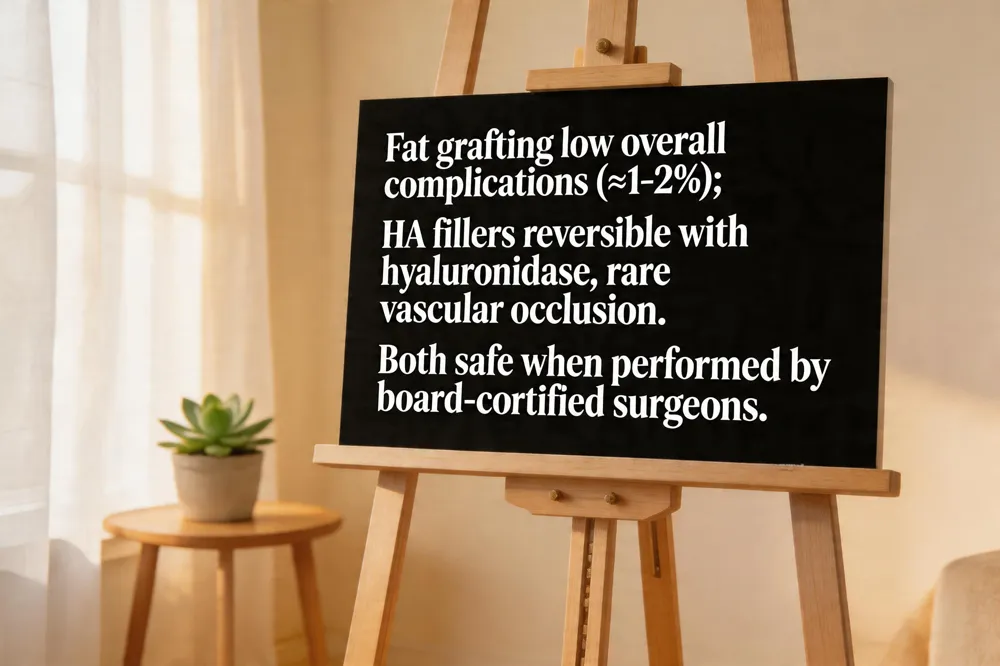
Both hyaluronic‑acid HA fillers and autologous fat transfer are considered safe when performed by a board‑certified specialist such as Dr. Victor Liu, but each carries a distinct risk profile.
Complication rates for fat grafting – Clinical series report low overall complication rates (≈1‑2 %). Reported events include donor‑site bruising, occasional infection, irregular contour or nodular fat formation, and fat necrosis. Because the tissue is the patient’s own, allergic reactions are essentially absent. Fat resorption (30‑70 % over the first year) may require a touch‑up, and a short recovery period (1‑2 weeks) is typical.
Complication rates for HA and other fillers – Fillers are associated with transient bruising, swelling, and mild edema in most patients. Rare but serious events include vascular occlusion, granuloma formation, and infection. Hyaluronic‑acid can be reversed with hyaluronidase, offering an adjustable safety net. Other synthetic fillers (calcium hydroxylapatite, poly‑L‑lactic acid) have similar short‑term profiles but are not easily reversible.
Allergic reactions and reversibility – Autologous fat carries virtually no allergy risk. HA fillers have a low hypersensitivity rate; when reactions occur they are usually mild and resolve with standard care. The ability to dissolve HA with hyaluronidase provides a unique advantage over permanent grafts.
Is filler or fat transfer safer? Both procedures are generally safe; the choice hinges on patient anatomy, tolerance for a minor surgical harvest, and the surgeon’s expertise.
Penuma implant** – The Penuma is a soft‑silicone sub‑cutaneous device placed via a minimally invasive incision to increase girth and flaccid length. Average gains are ~2.5 cm in length and ~3.1 cm in girth. Complications are low but include seroma formation (~12 %) and occasional revision surgery (~7 %). Proper patient selection and experienced surgical technique are essential for optimal outcomes.
Durability, Longevity and Maintenance

Survival of autologous fat grafts in the penile shaft varies with technique, processing, and patient factors, but studies consistently report 30‑70 % retention at 6‑12 months and up to 60‑70 % after one year when over‑correction is employed. The grafted adipocytes that revascularize become permanent tissue, offering a semi‑permanent girth increase that can last several years, although 10‑30 % of the volume is typically resorbed during the first year.
Synthetic dermal fillers differ markedly in durability. Hyaluronic acid (HA) gels provide 6‑12 months of volume, with some cross‑linked products lasting up to 18‑24 months; they are reversible with hyaluronidase. Calcium hydroxylapatite (CaHA) persists 12‑18 months, stimulating collagen for a firmer feel. Poly‑L‑lactic acid (PLLA) induces neocollagenesis and can maintain effect 12‑24 months after a series of injections. Polymethyl‑methacrylate (PMMA) microspheres are considered permanent, encapsulating in tissue but carrying higher long‑term risk of nodules.
Because fillers are eventually metabolized, repeat treatments or touch‑ups are required every 6‑18 months to sustain girth. Fat grafting, while requiring a one‑time liposuction harvest and a brief recovery, usually demands fewer revisions; occasional touch‑ups address resorption but are less frequent than filler replenishment.
Fat graft vs filler – Fat grafting uses the patient’s own harvested fat, offering natural texture and potential long‑term durability with a higher upfront cost and modest surgical step. Fillers provide immediate, predictable volume with minimal downtime but need regular re‑injection.
Fat transfer for girth – Autologous fat transfer (fat grafting) harvests adipose tissue, processes it, and injects it into the penile shaft, yielding an average 2 cm increase in circumference at six months while preserving sensation and erectile function. Complications are rare, most commonly small nodules that can be managed conservatively.
Fat transfer phalloplasty – This technique injects processed autologous fat into the sub‑cutaneous penile tissue, achieving a 1‑2 cm girth gain with minimal complications. The graft integrates with native tissue, providing a natural look and feel, and typically requires only occasional touch‑ups for minor volume loss.
Cost, Financing and Practical Considerations

Permanent male enlargement surgery cost
Penile girth enhancement via autologous fat transfer or silicone implants typically ranges from $8,000 to $20,000, while full‑lengthening procedures with premium implants can exceed $25,000. Prices include surgeon fees, anesthesia, facility charges, and post‑operative care, and they vary by region and surgeon expertise.
Male enlargement injections cost
Hyaluronic‑acid (HA) filler sessions start at about $1,000 for a small volume and can reach $10,990 for high‑volume packages that add up to 2 inches of erect girth. In major markets, 6 ml, 10 ml, and 15 ml HA treatments are priced around $3,990, $5,990, and $8,900 respectively, with financing options beginning at $199 per month. The PhalloFILL® protocol measures treatment in units, with 4–6 units at $2,800–$4,350 and 20 units or more at $9,900–$10,900.
Suspensory ligament surgery cost
Ligament release procedures generally cost between $15,000 and $25,000. Some clinics offer bundled packages for roughly $9,950, covering pre‑ and post‑operative care. Because the surgery is cosmetic, insurance coverage is rare; patients should anticipate out‑of‑pocket payment or explore financing.
Best male enlargement surgery before and after
A combined approach—suspensory ligament release with autologous fat grafting—provides both length and girth gains. Before surgery, patients often have a buried shaft; after, the penis protrudes more fully, gaining 1–2 cm of flaccid length and a smoother, fuller appearance. Recovery is typically 1–2 weeks, and satisfaction rates are high when performed by a board‑certified specialist.
Best male enlargement surgery
The most effective strategy is a personalized, minimally invasive enhancement performed by a board‑certified surgeon. Options include ligament release with silicone implants (e.g., FDA‑cleared Penuma®) or fat grafting, each tailored to the patient’s anatomy and goals for natural‑looking, lasting results.
Patient Selection, Expected Outcomes and Aftercare

Ideal candidates for penile girth enhancement have realistic expectations and good overall health. For autologous fat grafting men should have adequate donor‑site fat (BMI 20‑30), be non‑smokers, and lack uncontrolled diabetes or clotting disorders. HA filler candidates may have lower body fat, desire a minimally invasive, reversible option, and accept a temporary result lasting 12‑24 months.
Typical girth gains vary by modality: autologous fat grafting achieves a 20‑30 % increase (≈1‑1.5 inches), often stabilizing after 5‑6 months, while HA fillers provide an immediate 0.25‑0.50 in increase per session, with cumulative gains of 0.5‑1 inches after a few stages. Fat graft survival averages 40‑70 % at 12 months; HA filler retention is 90 % at four years with UroFill® but declines after the first month.
Post‑procedure care includes a brief abstinence period (72 hours for fillers, 4‑6 weeks for fat grafts), use of compression garments or gauze wraps, and scheduled follow‑up to monitor swelling, bruising, and graft integration.
FAQ
- How many inches does the XXL Penuma add? The XXL Penuma implant typically adds 1.5‑2.5 inches in length with a comparable girth increase, results vary by anatomy and healing.
- Penuma implant A soft‑silicone device placed via a minimal incision, yielding ≈1 inch length and ≈1.2 inch girth gains; complications are low but include seroma and occasional revision.
- How to make penis more girthy? Options include surgical fat grafting or silicone implants for permanent results, and HA filler injections for temporary, reversible enhancement.
- Penis enlargement treatment Offers surgical (fat graft, Penuma and non‑surgical (HA filler, vacuum traction) solutions performed by board‑certified surgeons.
- Penis enlargement non surgical HA filler injections add 2‑3 cm girth, are reversible with hyaluronidase, and require minimal downtime; other devices lack strong evidence.
- Penis enlargement surgery near me Seek a board‑certified plastic surgeon experienced in male genital enhancement, such as Dr. Victor Liu in the Bay Area, who offers Penuma implants and graft‑based techniques.
Choosing the Right Path Forward
A thorough, individualized evaluation by Dr. Victor Liu, a double‑board‑certified plastic surgeon, is the first step. He reviews the patient’s anatomy, donor‑site fat availability, health status, and aesthetic goals to recommend either autologous fat grafting or hyaluronic‑acid filler. Fat grafting offers semi‑permanent, natural‑feeling volume that can survive for years, but it involves liposuction, a longer recovery, and higher upfront costs. HA fillers provide immediate, reversible enhancement with minimal downtime and lower per‑session expense, yet they gradually resorb over 12‑18 months. Dr. Liu balances durability, safety, cost, and recovery to deliver a natural‑looking, lasting result tailored to each man’s expectations.