

Introduction
Penile enhancement has evolved from anecdotal remedies to a spectrum of evidence‑based interventions that address both functional and aesthetic concerns. Modern options include minimally invasive injectable fillers (hyaluronic acid, poly‑L‑lactic acid, polymethyl methacrylate, liquid silicone), autologous fat grafts, silicone implants such as the FDA‑cleared Penuma®, ligamentolysis, penile traction therapy, and adjunctive vacuum devices. Clinicians must assess overall health, vascular status, medication profile, smoking habits, and an‑anesthesia risk before selecting a procedure. Equally critical is a thorough psychological evaluation; up to 96 % of men seeking cosmetic enlargement report persistent small‑penis anxiety or penile dysmorphophobia, and many experience unchanged or worsened distress after surgery. Realistic expectations should be set regarding achievable length or girth gains, duration of results, recovery timelines, and potential complications. A multidisciplinary approach—combining urological expertise, plastic‑surgical skill, and counseling—optimizes safety, satisfaction, and long‑term sexual well‑being.
Surgical Solutions and Real‑World Results

Modern penile augmentation blends surgery with documentation. Minimally invasive ligament‑release techniques, such as scrotal‑approach suspensory ligament division, add 0.5–2 cm of flaccid length without a penile incision and preserve erection angle, showing low complication rates in reviews. Autologous fat grafting, after liposuction and purification, provides an average girth increase of 2.3 cm at six months; however, 30–70 % of transferred fat may resorb, causing variable shape and occasional nodules. Our clinic records measurements, standardized photographs, and post‑operative follow‑ups, creating a before‑and‑after gallery that demonstrates outcomes. Q: Best male enlargement surgery before and after – Dr. Victor Liu's procedure combines ligament release with fat grafting, achieving 0.5‑1.5 cm length and 1‑2 cm girth gains, documented with images. Q: Does penis enlargement surgery work – Modest gains (1‑3 cm) are possible, but success depends on technique, surgeon skill, and post‑op therapy; risks include infection, scarring, and fat loss. Q: Best male enlargement surgery – Laser‑assisted ligamentolysis paired with hyaluronic‑acid filler or autologous fat offers safe permanent enhancement, preserving sensation and allowing recovery.
Implant‑Based Girth Augmentation

Silicone‑based girth augmentation has become the most permanent, medically‑approved option for men seeking a permanent increase in penile circumference. The FDA‑cleared Penuma® sub‑cutaneous silicone sleeve is placed through a small scrotal or infrapubic incision and typically adds 2.5 cm (≈1 inch) to flaccid length and 3.1 cm (≈1.2 inches) to girth, producing a natural‑looking, firm shaft. By contrast, the older Himplant (now marketed as the H‑implant) yields a slightly smaller girth gain—about 1 to 2 inches—often with a modest flaccid length increase of ½ to 1 inch. Clinical series report high patient satisfaction: 81 % of Penuma recipients rate outcomes as high or very high, while Himplant studies show comparable satisfaction when patients are carefully selected. Complication rates remain low; Penuma implants have a 3 % overall revision rate and seroma in 4.8 % of cases, whereas Himplant complications are similar but slightly higher for infection. Both devices require a board‑certified surgeon, thorough pre‑operative counseling, and post‑operative follow‑up to ensure optimal safety and aesthetic results.
Oral Supplements and Their Reality
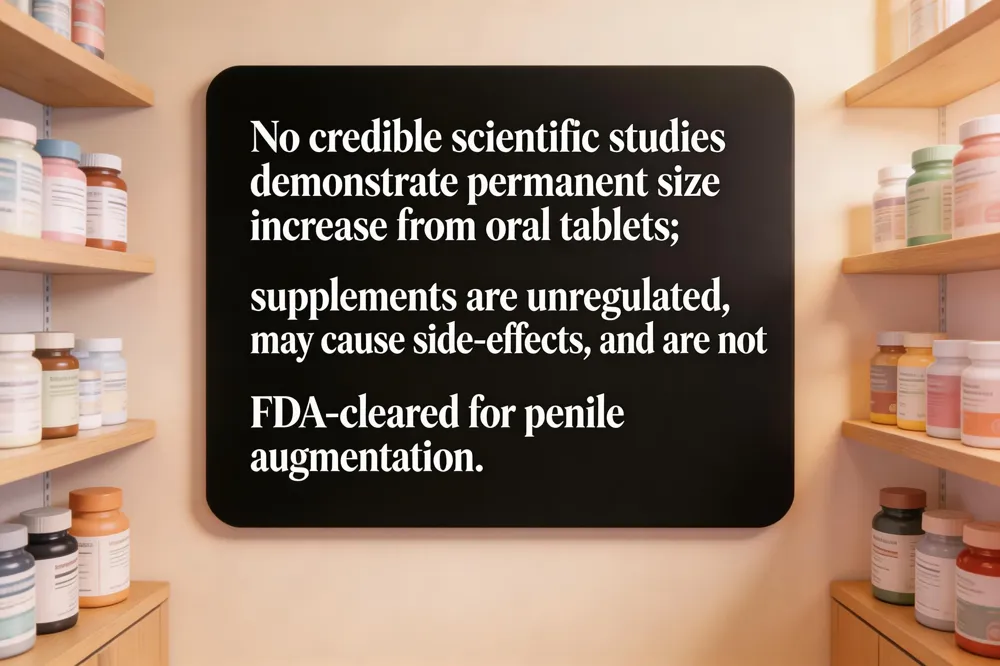
Penis enlargement tablets and male enlargement pills are widely advertised, yet no credible scientific study demonstrates a permanent increase in length or girth from oral products. The FDA does not evaluate these supplements; they often contain unregulated blends of vitamins, herbs, or hormones that can cause side‑effects or interact with medications. Quick‑fix claims are therefore unsupported and potentially unsafe.
Regulatory status: Dietary supplements are not FDA‑cleared for penile augmentation, and manufacturers are not required to prove efficacy or safety.
Common ingredients and risks: Ingredients such as herbal extracts, zinc, L‑arginine, or undocumented hormone analogues appear frequently, posing risks of hormonal imbalance, vascular issues, and allergic reactions.
Evidence‑based alternatives: Clinically validated options include penile traction therapy, vacuum erection devices, and, for selected patients, minimally invasive surgical augmentation performed by board‑certified specialists like Dr. Victor Liu.
Key Q&A:
- Penis enlargement tablet: No reliable evidence; safest routes are traction, vacuum, or surgeon‑guided procedures.
- Male enlargement pills: Unproven blends, potential side‑effects; consult a qualified urologist or plastic surgeon.
- Penis enlargement pills that work: None confirmed; temporary swelling may occur but is not lasting.
- Penis enlargement medication: Not FDA‑approved; consider evidence‑based treatments after professional assessment.
Finding the Right Surgeon and Clinic

Geographic considerations: Select a center within reasonable travel distance for follow‑up visits. Our Bay Area practice serves San Francisco, Oakland and nearby counties, with tele‑medicine for remote patients.
Dr. Victor Liu’s credentials: Double‑board‑certified plastic surgeon (ABPS, ABO) with fellowship training in male genital reconstruction, published work on HA fillers, tunica‑expansion and tissue‑engineered grafts, and extensive experience in minimally invasive phalloplasty.
Clinic safety: Procedures are performed in an accredited surgical suite using FDA‑cleared materials, strict sterile technique, intra‑operative monitoring and thorough pre‑/post‑op counseling.
Penis enlargement surgery near me – Our Bay Area clinic offers invasive procedures by Dr. Liu, including graft‑based lengthening, filler augmentation and regenerative therapies, with strict safety standards and consultations.
Penis enlargement clinic – Bay Area Penis Enlargement provides surgical and non‑surgical options under Dr. Liu, using FDA‑approved materials and personalized plans.
Penis enlargement surgery name – The medical term for this procedure is phalloplasty, also called penile enhancement surgery.
Non‑Surgical Strategies and Home Practices

Penile traction therapy (PTD) has demonstrated modest length gains of 1.7 cm after 6 months of daily 4–6 hour use, offering a favorable safety profile when performed under clinician guidance. Vacuum erection devices (VEDs) temporarily increase girth by drawing blood into the corpora but do not produce permanent enlargement; over‑use can damage elastic tissue and reduce erection firmness, so strict adherence to manufacturer instructions and physician oversight is essential. Lifestyle modifications such as weight loss and targeted abdominal fat reduction can reveal concealed shaft length, improving apparent size without surgery.
Real way to increase your size at home
There are no scientifically proven, permanent methods to significantly increase penis size that can be safely performed at home without professional oversight. While vacuum devices can temporarily enhance girth, “exercises” like jelqing lack credible evidence and may cause tissue damage. Over‑the‑counter creams and supplements are unregulated and ineffective. Consult a board‑certified specialist for evidence‑based options.
Male enhancement
Male enhancement includes treatments to improve size and erectile function. Many OTC products lack proof and can cause harm. Reliable options are offered by board‑certified surgeons such as Dr. Victor Liu, who provides personalized, minimally invasive procedures with natural‑looking results and minimal downtime.
Penis enlargement treatment
Enlargement can be non‑surgical or surgical; non‑prescription pills and “jelqing” are not recommended. Dr. Liu offers hyaluronic‑acid filler injections for girth gains up to 1.5 inches and surgical phalloplasty for medically indicated cases, ensuring safety, realistic expectations, and comprehensive after‑care.
Costs, Financing, and Value of Interventions

Understanding the financial landscape of penile enhancement helps patients set realistic expectations and choose safe, evidence‑based options.
Breakdown of injection and surgical expenses – Injectable fillers such as hyaluronic‑acid or PMMA typically cost $1,000‑$9,000 per session, with full treatment cycles ranging $10,000‑$13,000. Unit‑priced protocols (e.g., PhalloFILL®) vary from $2,800 for a ‑unit package to $10,900 for a 20‑unit regimen. Surgical procedures differ widely: ligamentolysis (lengthening) $15,000‑$25,000, autologous fat grafting $3,500‑$8,500, and silicone‑implant or advanced dermal‑filler surgeries $10,000‑$19,000. Dr. Victor Liu’s comprehensive Los Angeles package averages $12,000‑$20,000, covering pre‑op evaluation, anesthesia, the procedure, postoperative care, and follow‑up.
Insurance considerations – Most cosmetic enlargement procedures are classified as elective and are not covered by private insurers or Medicare. However, surgery performed for functional indications (e.g., buried penis, micropenis) may qualify for partial reimbursement after medical justification.
Financing options for patients – Clinics frequently offer payment plans, zero‑interest financing, or medical‑credit programs to spread costs. Dr. Victor Liu’s practice works with patients to customize financing and explore any possible insurance benefits for medically indicated cases.
Safety Profile, Side Effects, and Global Options

Penile augmentation, whether performed with injectable fillers, autologous fat grafts, or silicone implants, carries a predictable set of complications. The most frequent adverse events are infection at the injection or incision site, which may require antibiotics or revision surgery, and scarring or tissue fibrosis that can reduce elasticity, cause painful erections, or alter sensation. Post‑operative curvature, graft contracture, and, in rare cases, loss of erectile function have been documented across techniques.
Medical tourism offers cost‑effective access to these procedures, particularly in Turkey where laser‑guided ligamentolysis, fat‑graft girth augmentation, and Penuma® silicone implants are performed by board‑certified urologists at prices ranging from $3,400 to $5,500. Clinics adhere to European safety standards, include pre‑operative testing, and often integrate PRP or stem‑cell therapies to enhance healing.
Psychological distress linked to perceived small penis size persists after many cosmetic interventions; up to 96 % of patients report unchanged or worsened anxiety, underscoring the need for pre‑operative counseling and realistic expectations.
Penis enlargement surgery side effects
Infection, scarring, fibrosis, loss of sensation, postoperative curvature, erectile dysfunction, and dissatisfaction with cosmetic outcome are the principal risks; revision surgery may be required for uneven girth or unnatural appearance.
Penis enlargement surgery in Turkey
Turkish clinics combine advanced, minimally invasive techniques with lower costs ($3,400‑$5,500) and European‑level safety protocols, offering laser‑guided ligamentolysis, fat‑graft girth augmentation, and Penuma® implants performed by board‑certified surgeons.
Is 7 inches huge for a guy?
The average erect length is 5.1‑5.5 inches; a 7‑inch penis lies near the 95th percentile, larger than most but not extremely rare, representing about 5‑10 % of men.
Underlying Biology and Hormonal Factors

Genetics set penile dimensions; hormone‑receptor gene variations affect final length and girth.
Testosterone drives penile growth during puberty; growth hormone contributes to stature but lacks a proven role in adult penile enlargement.
Pubic fat can hide shaft length, and weight loss or liposuction can restore apparent size.
What makes a man's thing bigger?
Penis size is set mainly by genetics and the testosterone surge of puberty. Good nutrition and healthy weight support normal growth, while pubic fat can make the organ look smaller. Hormonal issues such as low testosterone may limit development, and over‑the‑counter products lack evidence and can be unsafe. Enlargement requires procedures performed by qualified specialists like Dr. Victor Liu.
Penis growth hormone
Penis growth hormone, often confused with testosterone, is not approved for enlarging adult penises. Human growth hormone aids overall body development but does not increase penile length or girth in grown men. Clinics such as Dr. Victor Liu’s use surgical or minimally invasive methods rather than unproven hormone therapy.
Conclusion
The current literature indicates that modest, reversible girth gains of 2–3 cm are reliably achieved with injectable hyaluronic‑acid or poly‑L‑lactic‑acid fillers, while penile traction devices produce an average flaccid length increase of 1.5–2 cm after months of daily use. Surgical options such as suspensory‑ligament release, autologous‑fat grafting, the FDA‑cleared Penuma silicone implant, and emerging tunica‑expansion techniques can add 2–5 cm of girth or length but carry higher rates of infection, scarring, and irregularities. Tissue‑engineered biodegradable scaffolds seeded with autologous fibroblasts show promise for durable augmentation with low complication rates. Future research should prioritize long‑term comparative trials, standardized measurement protocols, and development of safer, bio‑compatible biomaterials, including controlled‑release fillers and stem‑cell‑based therapies. Patients seeking enhancement must undergo comprehensive medical and psychological screening, choose board‑certified urologists or plastic surgeons, set realistic expectations, and adhere to postoperative follow‑up to minimize risks and achieve personalized, safe outcomes. Integrating sexual counseling enhances long‑term confidence and relationship quality and satisfaction.