

Setting the Stage for the Future of Male Enhancement
The global sexual‑health supplement market is expanding rapidly, projected to reach $5.3 billion by 2030 with a CAGR of 8.8%, driven by heightened consumer awareness and demand for natural, personalized formulas delivered through e‑commerce channels. Simultaneously, innovative formats—from herbal gummies to bio‑engineered nanofillers—are reshaping male‑genital enhancement. Emerging technologies such as hyaluronic‑acid and biodegradable polymer fillers, low‑intensity shockwave therapy, platelet‑rich plasma, stem‑cell‑enriched grafts, and 3‑D‑printed patient‑specific prostheses promise greater efficacy with reduced invasiveness. Because regulatory scrutiny and safety concerns are intensifying, clinicians and patients must prioritize evidence‑based, minimally invasive options that combine rigorous clinical data with personalized treatment planning, ensuring discreet, effective, and reproducible outcomes.
Surgical Solutions: Implants, Grafts, and Tunica Expansion
 Permanent penile enlargement is reliably achieved only through surgical interventions. The FDA‑cleared Penuma silicone implant, placed beneath the tunica albuginea via a small scrotal incision, typically adds 1–2 inches of girth and modest length gains while preserving erectile function. Clinical series report average girth increases of 3.1 cm and flaccid length gains of 2.5 cm, with patient satisfaction rates above 80 %. Complications are low when performed by board‑certified surgeons; infection, seroma, and implant migration are the most common risks.
The Tunica Albuginea Expansion (TEP) technique, refined by Dr. Robert Valenzuela, uses 2–3 mm staggered incisions to place pleats in the tunica, delivering 2–3 cm of length or girth without compromising blood flow. A scrotal approach eliminates the need for circumcision and reduces infection rates to under 1 % in high‑volume series.
Cost considerations vary: Penuma procedures range from $7,000 to $12,000, while TEP procedures fall between $8,000 and $15,000, inclusive of surgeon fees, anesthesia, and postoperative care. Patient selection hinges on realistic expectations, stable health, and a thorough pre‑operative evaluation to minimize complications and ensure optimal, natural‑looking results.
Minimally Invasive Fillers, Injections, and Regenerative Approaches
 The market for low‑risk, office‑based male‑enhancement procedures is expanding rapidly, driven by consumer demand for discreet, reversible options. Hyaluronic‑acid (HA) fillers are the most widely used injectable for girth augmentation. Large‑scale retrospective data (≈ 500 men) show modest increases of 0.5–1 inch, a smoother contour and only minimal downtime. Complications are rare—two injection‑site infections, three granulomas and a few cases of priapism resolved with hyaluronidase—while no persistent erectile dysfunction has been reported. Results last 6‑12 months, requiring repeat treatments.
Male enlargement injections before and after – FDA‑approved dermal fillers (HA, Bellafill®) provide a girth gain of roughly 0.5–1 inch, visible within days and peaking after filler settlement. Before‑and‑after photos demonstrate fuller, more symmetrical shafts while preserving natural texture. The procedure is minimally invasive, performed with micro‑cannula technique, and is reversible.
Male enlargement injections cost – Pricing depends on the filler and volume. HA sessions range $500‑$1,200; PhalloFILL® starts at $2,800‑$3,100 for 4 units and can exceed $10,000 for larger regimens. Financing plans are commonly offered.
Peptides for penis growth – Experimental peptides (e.g., VIP, anti‑lysyl oxidase) have shown temporary, dose‑dependent length/girth changes in early trials, but no FDA‑approved product exists and long‑term safety is unknown.
Stem cell penis enlargement – Autologous mesenchymal stem‑cell injections aim to regenerate tunica albuginea and increase girth. Early clinical reports suggest modest gains and improved vascularity, yet large‑scale safety data are lacking.
Does male enhancement increase size? – Medically supervised procedures can add 0.5‑2 cm in length or 1‑3 cm in girth, depending on technique. Nonsurgical modalities (PRP, traction, low‑intensity shockwave) yield smaller gains (0.3‑1 cm). Over‑the‑counter pills lack credible evidence. Consultation with a board‑certified specialist is essential to align expectations with evidence‑based outcomes.
Emerging Male Contraception: Near‑Future Options
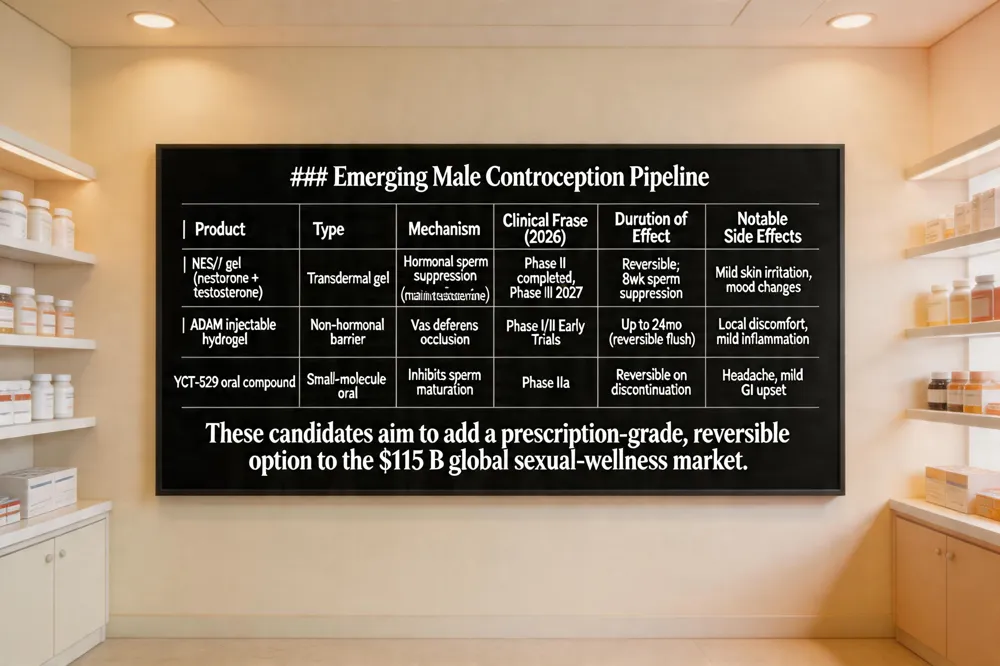 The pipeline for reversible male contraception is expanding rapidly, with both hormonal and non‑hormonal candidates approaching market readiness. The most advanced hormonal product is a transdermal gel that combines the progestin nestorone (Nestorone) with testosterone (NES/T gel). Phase II trials have demonstrated reliable suppression of sperm production to contraceptive levels within eight weeks while maintaining normal systemic testosterone, and a Phase III study is slated for launch by 2027. In the non‑hormonal arena, the injectable hydrogel known as ADAM (derived from the Vasalgel platform) creates a temporary, reversible barrier in the vas deferens; early human data show sustained azoospermia for up to 24 months with only mild, short‑term side effects. A novel oral compound, YCT‑529, targets sperm maturation and is currently in Phase IIa testing, with a projected Phase III entry later this decade.
These innovations could reshape the male sexual‑health market, adding a premium, privacy‑focused product line that complements the $115 billion global sexual‑wellness industry. While condoms, vasectomy, and limited spermicides remain the only FDA‑approved options today, the near‑future may see the first prescription‑grade male birth‑control gel and injectable gel, offering men safe, reversible, and minimally invasive contraception within the next few years.
Patient‑Centric FAQ: Size Perception and Practical Guidance

Understanding penis size norms
According to population studies, the average erect length for U.S. men falls between 5.1 in and 5.5 in (≈13 cm). A 7‑inch erect penis (≈18 cm) places a man near the 95th percentile, meaning only a small minority exceed this measurement. While it is technically "large," size alone does not dictate sexual satisfaction.
Realistic expectations for enhancement
Non‑surgical options such as hyaluronic‑acid fillers (e.g., Diamond XL 360™), PRP‑based P‑Shot, or low‑intensity shockwave therapy can modestly increase girth (≈1–3 cm) or length (≈0.5–1 cm) but do not produce dramatic changes. Surgical techniques—penile prosthesis implantation with tunica expansion, Penuma® silicone implants, or autologous fat grafting—can add 2–5 cm in girth and up to 5 cm in flaccid length, yet they carry higher risk of infection, scarring, and altered sensation. Patients should view enhancement as a means to improve confidence, not a guarantee of superior performance.
Safety and after‑care considerations
Complication rates for modern fillers are <5 % when performed by board‑certified urologists or plastic surgeons with experience in genital procedures. Post‑procedure protocols typically include a brief period of limited sexual activity (1–2 weeks), monitoring for infection, and follow‑up imaging to ensure proper placement. Regenerative therapies (stem‑cell injections, PRP) remain investigational; patients should enroll in clinical trials with IRB oversight.
How to choose a qualified provider
Select clinicians who are fellowship‑trained in urology or plastic surgery, publish peer‑reviewed outcomes, and adhere to sterile, FDA‑compliant protocols. Verify that the practice offers comprehensive counseling, realistic outcome modeling (often using AI‑driven imaging), and transparent discussion of costs, insurance coverage, and potential risks.
Answer to the specific question
Is a 7‑inch penis big or small? A 7‑inch erect penis is well above the U.S. average, landing near the 95th percentile. It is therefore considered "large" rather than "small." While a longer penis can boost confidence, it may require adjustments in foreplay and positioning to ensure partner comfort. Ultimately, sexual satisfaction depends on many factors beyond size, including communication, emotional intimacy, and overall health.
Market Outlook & Future Innovations
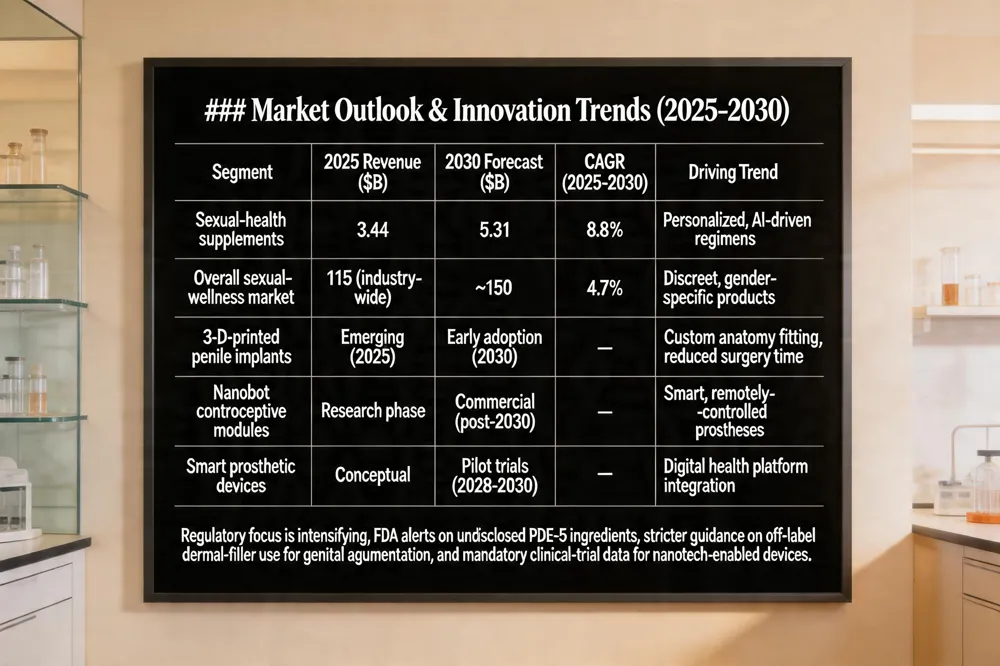 The global sexual‑health supplement market is expanding rapidly, with revenues projected to rise from $3.44 billion in 2025 to $5.31 billion by 2030 (≈8.8% CAGR) and the broader sexual‑wellness market expected to reach $115 billion by 2030 (≈4.7% CAGR). Growth is driven by heightened consumer awareness of wellness, a surge in demand for natural, gender‑specific formulas, and the ubiquity of e‑commerce, which now accounts for over 50% of sales in the United States and is projected to exceed 56% globally by 2034. Personalized regimens—ranging from botanical gummies to customized hyaluronic‑acid fillers—are becoming the norm as AI‑driven imaging and predictive algorithms match patients’ vascular, hormonal, and anatomical profiles to the optimal product or procedure. Emerging technologies such as 3‑D‑printed, patient‑specific penile implants, nanobot‑based contraceptive or sensory modules, and smart prostheses controllable via smartphone are poised to reshape the market over the next decade. At the same time, regulators are tightening oversight: FDA alerts on undisclosed PDE‑5 ingredients, new guidance on off‑label dermal‑filler use for genital augmentation, and mandatory clinical‑trial data for nanotech‑enabled devices are all pushing manufacturers toward greater transparency, safety testing, and post‑marketing surveillance. Together, these forces suggest a future where male‑enhancement solutions are more effective, discreet, and scientifically validated, while consumer confidence is reinforced by robust regulatory frameworks.
Looking Ahead: Informed Choices for a Confident Future
Patients should start with a thorough evaluation that integrates medical history, vascular imaging, and hormone testing to select evidence‑based pathways such as low‑intensity shockwave therapy, PRP, or FDA‑cleared implants. Safety remains paramount; clinicians prioritize minimally invasive fillers or autologous stem‑cell protocols that deliver predictable girth gains while minimizing infection risk. Ongoing research—ranging from 3‑D‑printed prostheses to AI‑driven treatment planning—must be communicated transparently, empowering men to make informed, confident decisions about their sexual health today.