

Introduction
Penile enhancement encompasses a spectrum of options ranging from nonsurgical modalities—such as vacuum erection devices, traction therapy, and injectable hyaluronic‑acid (HA) fillers—to surgical interventions that include suspensory‑ligament release for flaccid‑lengthening and girth augmentation via autologous fat grafts, dermal fillers, or silicone implants. Men pursue lengthening or girth augmentation primarily because up to 45 % report size‑related dissatisfaction, yet most fall within normal anatomical ranges; psychological distress, body‑image concerns, and partner perception often drive the desire for change. Evidence‑based safety hinges on patient selection, board‑certified surgeons, and adherence to sterile technique. Complication rates are below 5 % when performed by qualified urologists or plastic surgeons, whereas unlicensed providers exhibit markedly higher infection, scarring, and sensory‑loss incidences. Comprehensive counseling and realistic expectations remain central to optimal outcomes.
Evaluating Lengthening vs. Girth Options
 Penile lengthening relies on suspensory ligament release or grafting techniques, which typically add 0.5–2 cm (0.2–0.8 in) to flaccid length without significantly changing erect length. Girth augmentation can be achieved with autologous fat grafts, dermal fillers, or silicone implants such as the Penuma® or Himplant. Hyaluronic‑acid fillers provide a semi‑permanent 1.7–3.9 cm (0.7–1.5 in) girth increase with low complication rates, while permanent implants add 2.5–5 cm (1–2 in) in circumference and may modestly improve flaccid length. Comparative outcomes show that non‑surgical filler protocols (e.g., Diamond XL 360) deliver immediate, reversible gains of 0.5–1 in in length and visible thickening, whereas combined surgical approaches (ligament release plus fat grafting) yield lasting enhancements of 0.5–1 in in both dimensions but require a 4–6‑week abstinence period. Patient satisfaction correlates strongly with realistic counseling, board‑certified surgeon expertise, and individualized postoperative plans, ensuring natural‑looking results while preserving erectile function.
Safety, Risks, and Patient Selection
 Complication rates vary by technique: surgical lengthening (ligamentolysis) and girth grafts have <5 % major adverse events when performed by board‑certified surgeon, whereas unlicensed providers report markedly higher infection, scarring, and sensory loss. Hyaluronic‑acid (HA) filler injections show a low 2 % complication rate, with most issues limited to transient swelling or bruising; permanent fillers such as PMMA carry higher long‑term nodule risk.
Choosing a board‑certified surgeon is essential. Board certification guarantees training in genital anatomy, sterile technique, and postoperative care, reducing complications to the <5 % range seen in accredited centers. Surgeons like Dr. Victor Liu, double‑board‑certified in plastic surgery and urology, employ minimally invasive protocols (e.g., HA + PMMA reinforcement) that achieve lasting girth enhancement with minimal downtime.
Medical contraindications include uncontrolled diabetes, coagulopathy, severe cardiovascular disease, active infection, or severe penile curvature. Pre‑operative counseling should address realistic expectations, discuss the temporary nature of HA fillers (12‑18 months), outline cost ranges (injection $1,000‑$9,000; permanent surgery $15,000‑$25,000), and ensure psychological screening for body‑dysmorphic concerns. This comprehensive evaluation protects patient health and aligns outcomes with personal goals.
Non‑Surgical and Natural Strategies
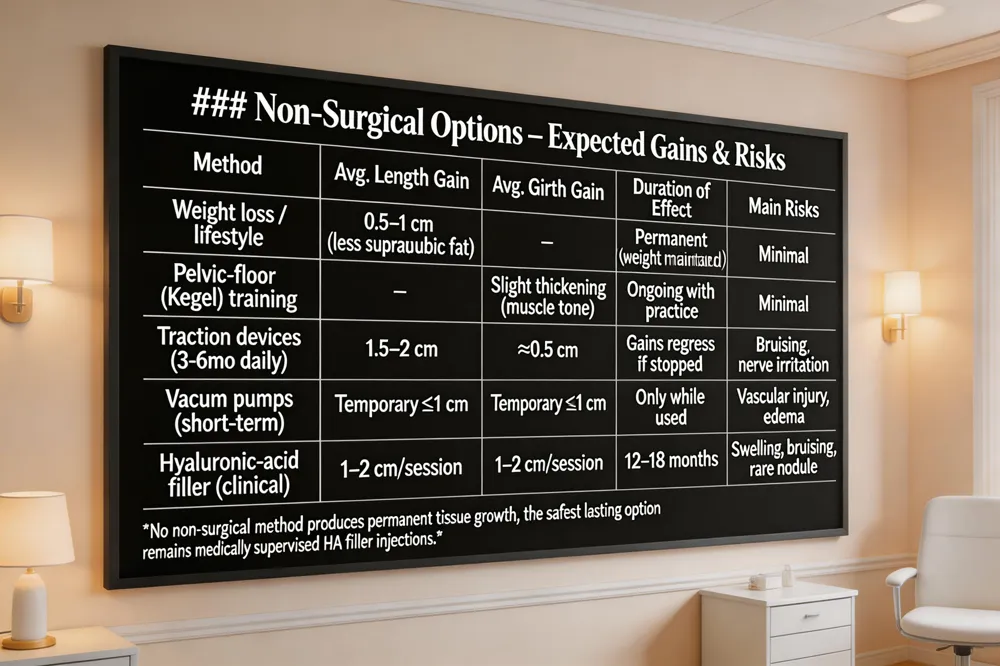 Lifestyle factors can subtly improve perceived penile size. Maintaining a healthy weight reduces suprapubic fat, exposing more shaft length, while regular aerobic exercise and a diet rich in omega‑3s and antioxidants enhance vascular health and erection firmness. Pelvic‑floor (Kegel) training improves muscle tone, supporting better rigidity and a fuller appearance.
Traction, vacuum, and calibrated stretching devices are the only mechanical methods with modest, evidence‑based gains. Clinical studies report an average increase of 1.5‑2 cm in flaccid length after 3‑6 months of daily traction, and temporary girth expansion with short‑term vacuum use. Proper technique, consistent use, and adherence to device‑specific protocols are essential to minimize risks such as bruising, nerve irritation, or tissue damage.
Evidence‑based efficacy and risks: Non‑surgical options provide only temporary or modest improvements; no method produces permanent tissue growth. Over‑use of vacuum pumps or aggressive stretching can damage elastic tissue and reduce erection quality. For lasting enhancement, medically supervised options—such as hyaluronic‑acid filler injections—remain the safest and most predictable choice. Schedule a confidential consultation with Dr. Victor Liu to discuss individualized, evidence‑based strategies.
Financial Considerations and Realistic Expectations
 Penile enhancement pricing varies widely. Non‑surgical hyaluronic‑acid fillers cost $2,250‑$2,750 per session, with a typical three‑session course totaling $6,000‑$8,000. Autologous fat grafting and silicone implants (e.g., Penuma®) range from $10,000‑$25,000, reflecting operating‑room fees, anesthesia, and graft material. Insurance rarely covers cosmetic augmentation; most plans exclude elective procedures unless a functional indication such as micropenis is present. Financing options include medical‑care loans, CareCredit, and in‑clinic payment plans that spread costs over 12‑36 months, allowing men to pursue their goals without upfront burden.
A “big” girth exceeds the average erect circumference of 11.7 cm (4.6 in). Measurements of ≥13 cm (5 in) are considered large, while ≥16 cm (6.3 in) are exceptional and occur in only ~5 % of men.
Realistic gains: injectable HA fillers typically add 1‑2 cm per session (≈0.5‑0.8 in); cumulative results of 2‑3 cm after a full course feel natural. Surgical grafts or silicone implants can add 3‑5 cm (≈1.2‑2 in) but carry higher complication rates and longer downtime.
Permanent enlargement is best achieved through board‑certified surgical options—fat grafting, silicone implants, or HA filler with hyaluronidase reversibility. Dr. Victor Liu’s practice offers personalized financing, thorough pre‑operative counseling, and minimally invasive techniques that balance safety with lasting, natural‑looking results.
Psychological Impact and Partner Preferences
 Body image and sexual confidence Up to 45 % of men report dissatisfaction with penile size, yet most fall within normal dimensions. Studies show that girth augmentation—especially with hyaluronic‑acid fillers—yields average increases of 2.8 cm (≈1 inch) and high satisfaction, while surgical grafts can add 1–2 cm but carry higher complication rates. Partner satisfaction trends Multiple surveys (e.g., BMC Women’s Health, UCLA/PLOS ONE) consistently indicate women value girth more than length, citing greater friction and fullness during intercourse; roughly 70 % rate girth as the more important factor. Importance of counseling and realistic goals Pre‑operative counseling that includes psychological screening, realistic expectation setting, and discussion of partner preferences markedly improves outcomes. Evidence links thorough counseling to higher long‑term satisfaction and lower regret.
Do girls prefer girth or length more? Women generally prefer girth; studies show a clear preference for thicker over longer penises for sexual pleasure.
How much girth increase is realistic? Non‑surgical HA fillers typically add 1–2 cm per session (cumulative 2–3 cm), while surgical grafts or silicone implants can add 3–5 cm, but with increased risk. A modest 2–3 cm gain is most common and feels natural.
Conclusion
Key take‑aways for safe decision‑making include recognizing that most men fall within normal size ranges, that temporary, minimally invasive options such as hyaluronic‑acid fillers offer modest girth gains with low complication rates, and that surgical lengthening or grafting provides only limited flaccid‑length improvement and carries higher risks. Patients should undergo thorough medical and psychological screening, discuss realistic expectations, and choose a board‑certified urologist or plastic surgeon with specific genital‑enhancement training. Next steps for interested individuals are to schedule a confidential consultation, obtain objective baseline measurements, and explore non‑surgical adjuncts (traction, weight loss) before committing to surgery. Our practice is committed to personalized care, using evidence‑based techniques, sterile environments, and postoperative support to achieve safe, natural‑looking outcomes and long‑term satisfaction for patients.