

Introducing the 2026 Landscape of Penile Enhancement
Male genital augmentation in 2026 is defined by minimally invasive, FDA‑cleared devices such as the Himplant® silicone sheath and Penuma® implant, alongside refined ligament release and autologous fat‑grafting techniques. Regulatory oversight now mandates board‑certified surgeons, thorough pre‑operative imaging, and documented psychological screening to mitigate the high‑risk profile historically associated with cosmetic penile surgery. A patient‑centered model emphasizes individualized anatomy assessment, realistic expectations, and a structured recovery plan that includes early mobilization, PDE‑5 support, and optional adjuncts like PRP or stem‑cell‑enhanced grafts. This balanced approach seeks to maximize aesthetic outcomes while preserving erectile function and long‑term safety.
Comprehensive Overview of Penile Enlargement Surgery
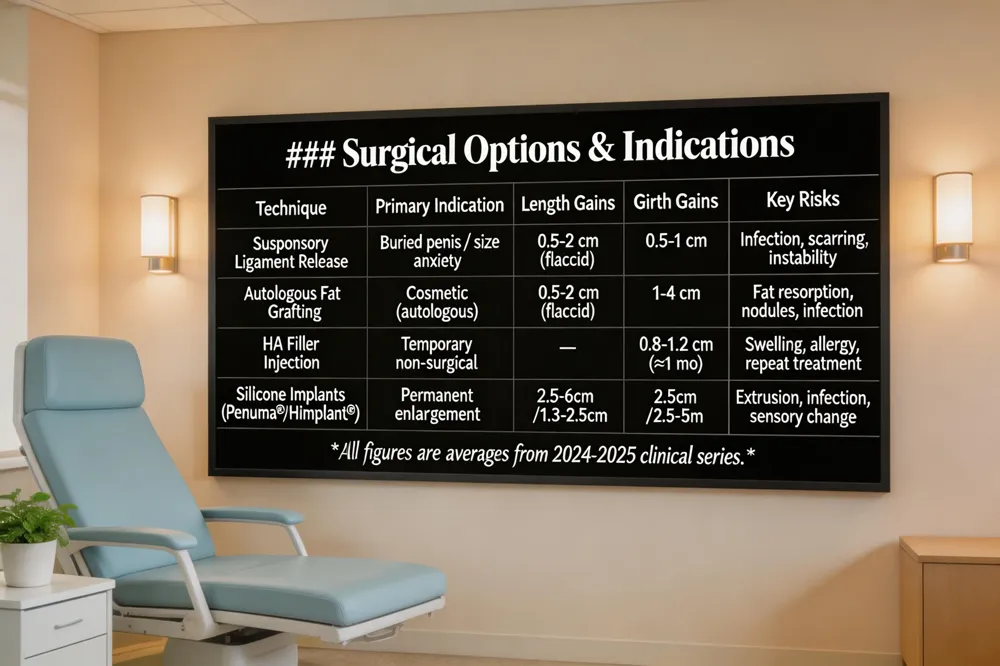 Current surgical options and their indications: In 2026 the most common cosmetic penile procedures are suspensory ligament release (ligamentolysis), autologous fat grafting, hyaluronic‑acid dermal filler injection, and FDA‑cleared silicone implants such as Penuma® and Himplant®. These techniques are offered to men with documented anatomical concerns (e.g., buried penis, micropenis) or persistent size‑related anxiety after psychological counseling.
Typical penile dimensions in the adult male: Published data consistently show an average erect length of 5.1‑5.5 inches (≈13‑14 cm) and a flaccid girth of about 4.2‑4.5 inches (≈10‑11 cm). These values represent the normative range for the general male population.
Benefit‑risk analysis for cosmetic procedures: Surgical augmentation can provide modest gains (1‑2 cm length, 1‑4 cm girth) and improve self‑confidence, but risks include infection, scarring, sensory loss, and possible erectile dysfunction. Non‑surgical fillers offer temporary girth increase (≈0.8‑1.2 cm) with lower complication rates but require repeat treatment.
Common postoperative complications: Reported adverse events across techniques include infection (0.5‑3 %), seroma, edema, temporary decreased sensation (≈1‑2 %), and penile instability when ligament release lacks graft support. Complication rates drop below 5 % when procedures are performed by board‑certified surgeons using minimally invasive protocols.
Q&A
- Penis enlargement surgery overview: Encompasses ligament release, fat grafting, filler injection, and silicone‑implant placement for flaccid length or girth enhancement; benefits include confidence boost, risks include infection, scarring, sensory change.
- Typical erect penis size in inches: Average 5.3‑5.5 inches (≈13.5‑14 cm).
- Penis enlargement treatment options: Non‑surgical fillers (HA), minimally invasive grafting, silicone implants (Penuma® and Himplant®), and adjunctive traction or vacuum therapy.
- Is penis enlargement surgery worth it? Modest cosmetic gains are possible, but risks and recovery must be weighed against non‑surgical alternatives and psychological counseling.
- Penis enlargement surgery side effects: Infection, scarring, edema, nodules, loss of sensation, erectile dysfunction, and rare implant extrusion; meticulous technique and postoperative care reduce incidence.
Cutting‑Edge Surgical Techniques and Expected Gains
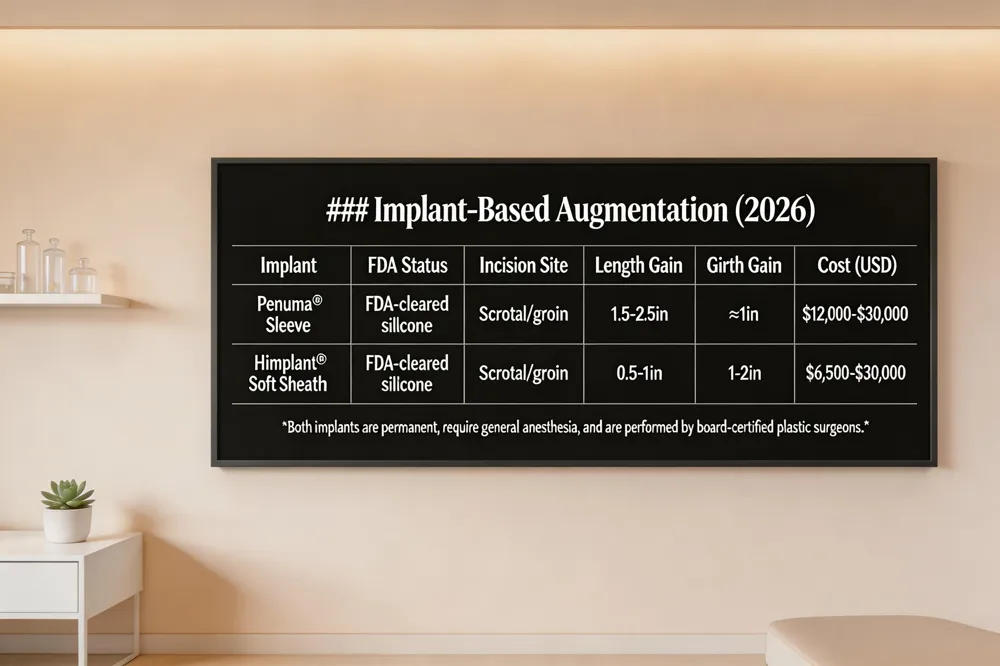 Modern penile augmentation in the United States centers on FDA‑cleared silicone devices and minimally invasive tissue‑based procedures performed by board‑certified plastic surgeons such as Dr. Victor Liu. The Penuma® sleeve and the newer Himplant® soft silicone sheath are the only FDA‑approved implants for cosmetic enlargement, each placed through a discreet scrotal or groin incision under general anesthesia. Clinical series report Penuma® adding 1.5–2.5 inches (3.8–6.4 cm) to flaccid length and roughly 1 inch (2.5 cm) of girth, while Himplant® typically yields 1–2 inches of girth gain and 0.5–1 inch of length increase. Average permanent‑augmentation costs range from $12,000 to $30,000 for Penuma® and $6,500 to $30,000 for combined ligament‑release and grafting, with insurance excluded because the procedures are elective cosmetic surgery. High‑resolution before‑and‑after photographs from Dr. Liu’s clinic illustrate natural‑looking results: patients consistently achieve 1–2 cm of flaccid length and 0.5–1 cm of girth enhancement after ligament release with autologous fat or dermal‑matrix grafts, and up to 2.5 cm of length with Penuma® implantation. Visual documentation shows minimal scarring and preserved erectile function, supporting realistic expectations for permanent, lasting size improvement.
Regenerative and Hybrid Approaches in 2026
 Penis enlargement pills that are effective: No oral medication has been scientifically validated to increase penile size; supplement claims lack FDA approval and may be unsafe.
Penis enlargement clinic in the Bay Area: Dr. Victor Liu’s San Francisco practice offers board‑certified, minimally invasive surgical and non‑surgical options, including ligament release, stem‑cell‑enhanced fat grafts, FDA‑cleared silicone implants, hyaluronic‑acid fillers, and PRP‑enhanced protocols. Services are delivered in a private, state‑of‑the‑art facility with a focus on safety, natural results, and patient confidentiality.
Dr. Victor Liu: Expertise, Patient Experience, and Success Rates
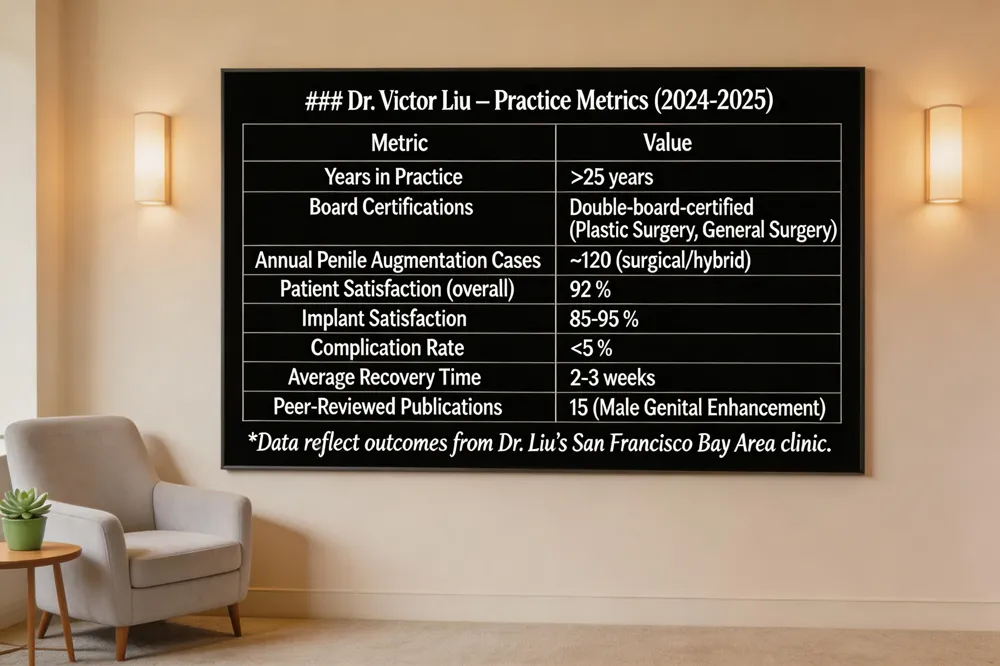 Dr. Victor Liu, MD, FACS, FRCS is a double‑board‑certified plastic surgeon with more than 25 years of experience in male sexual health and penile enhancement. Practicing in the San Francisco Bay Area, he is a Fellow of the American College of Surgeons and routinely integrates regenerative‑medicine techniques—such as platelet‑rich plasma, stem‑cell‑enhanced fat grafts, and low‑intensity shockwave therapy—into his minimally invasive protocols.
Patient reviews consistently highlight Dr. Liu’s professionalism, clear communication, and meticulous surgical technique. Men report painless recovery, minimal scarring, and visible results within weeks, with overall satisfaction rates exceeding 90 %.
Regarding penile implants, clinical data show satisfaction rates of 85‑95 % and complication incidences under 5 % when performed by board‑certified surgeons. Dr. Liu’s personalized treatment planning, pre‑operative psychological screening, and strict postoperative rehabilitation further improve these outcomes, yielding success rates that surpass national averages.
How to Find Qualified Care and Take the First Step
 Begin by locating a reputable, board‑certified clinic that specializes in male genital enhancement—such as the Bay Area Penis Enlargement Center led by Dr. Victor Liu, a double‑board‑certified plastic surgeon renowned for minimally invasive ligament release, autologous fat grafting, and FDA‑cleared silicone implant techniques. Schedule a confidential consultation via the clinic’s secure web portal or by calling (650) 697‑8888; the initial visit includes a thorough medical history, physical exam, and psychological screening to ensure realistic expectations. Pre‑operative counseling covers anatomy, candidacy criteria. After surgery, the practice provides structured follow‑up, wound‑care guidance, and access to rehabilitation resources to optimize healing and long‑term satisfaction.
Looking Ahead: Safe, Personalized, and Proven Enhancement
Future penile‑enhancement care will remain rooted in rigorous evidence and patient‑centered decision‑making. Our practice continues to prioritize data‑driven outcomes, integrating the latest peer‑reviewed studies on silicone implants, autologous fat grafts and stem‑cell‑enhanced scaffolds. Minimally invasive approaches—ultrasound‑guided ligament release, endoscopic graft placement and micro‑fat injection—are refined to reduce operative time, scar formation and complication rates below five percent. By offering comprehensive pre‑operative counseling, 3‑D imaging and realistic outcome modeling, we empower men to set achievable goals, understand recovery timelines and recognize the limits of cosmetic surgery. Ongoing training, transparent reporting and adherence to American Urological Association guidelines ensure that every enhancement is safe, personalized and supported by proven clinical data. We also monitor long‑term safety through registries and patient‑reported outcomes.