

Introduction: Why Girth Matters for Sexual Confidence
A sizable proportion of men experience anxiety about penile girth, with surveys indicating that up to 55 % of adult males feel dissatisfied with their circumference and associate this with reduced sexual confidence. Augmentation options range from minimally invasive fillers—most commonly hyaluronic‑acid (HA) injections that add 1–3 cm of girth and last 12–18 months—to autologous fat grafts and surgical grafts (dermal‑fat, Alloderm, silicone implants) that can provide more permanent gains of 1–2 cm but carry higher infection and scarring risks. Clinical data show that even modest girth increases improve tactile stimulation for partners, elevate self‑esteem, and modestly enhance sexual pleasure, although objective erectile function typically remains unchanged. Understanding these epidemiologic trends, technique profiles, and functional outcomes helps men set realistic expectations and seek safe, board‑certified care.
Understanding Girth Augmentation Mechanics
 Penile girth is determined by the sub‑cutaneous tissue surrounding the corpora cavernosa; enhancing it can be achieved through non‑surgical fillers or surgical grafts. Hyaluronic‑acid (HA) fillers provide an immediate increase of 2–3 cm in flaccid girth, are reversible, and carry a low complication rate when performed by a board‑certified specialist. Surgical grafts, such as autologous fat transfer or dermal‑fat grafts, can yield larger, more durable gains but entail higher risks of infection, irregular contour, and longer recovery.
How long does a girth shot last? HA filler injections typically maintain volume for 12–18 months before gradual resorption; many patients schedule annual maintenance sessions and can dissolve the filler with hyaluronidase if needed.
Can a man increase girth naturally? Pelvic‑floor exercises, weight loss, and cardiovascular health may improve appearance but do not produce permanent tissue growth. Unproven methods (pills, jelqing, pumps) lack scientific support and can cause injury. Medically supervised fillers or grafts remain the only reliable options for lasting augmentation.
Hyaluronic acid girth enhancement cost? A full HA series generally ranges from $4,800 to $7,200 in the U.S., reflecting product price, number of syringes, and provider expertise; maintenance touch‑ups are needed every 12–24 months.
Clinical Evidence on Effectiveness
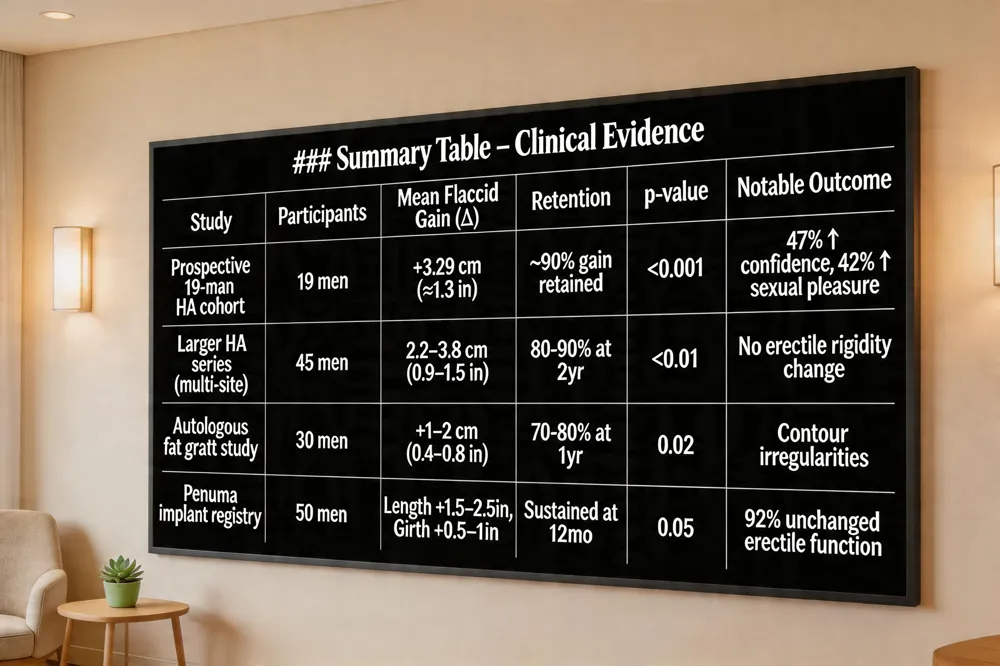 Multiple prospective studies confirm that nonsurgical hyaluronic‑acid (HA) fillers reliably increase penile girth. In a 19‑man cohort, mean flaccid girth rose from 9.5 cm to 12.79 cm (Δ 3.29 cm, p < 0.001). Larger series report average gains of 2.2–3.8 cm (≈0.9–1.5 in) within four weeks, with retention of ~90 % at four years after the initial settling period. Patient‑reported outcomes are consistently positive: 47 % of men note heightened self‑confidence and 42 % report greater sexual pleasure, while validated satisfaction scales show modest improvements. Before‑and‑after photographs typically display a smoother, fuller shaft without compromising erectile rigidity; sensation and erectile function remain unchanged in most reports.
Penis enlargement treatment – A spectrum of options exists, from minimally invasive HA fillers, PRP, and shockwave therapy to surgical grafts and implants. Each modality is tailored to anatomy, goals, and health, with board‑certified clinicians ensuring safety and realistic expectations.
Does girth enhancement really work? – Yes. Clinical data demonstrate measurable gains (0.25–0.5 in per HA session) and high volume retention, especially when performed by experienced specialists.
Hyaluronic acid girth enhancement before and after – Injections add 6–12 mm per session, producing a fuller appearance that becomes evident after 2–4 weeks of swelling resolution and can be maintained with periodic touch‑ups.
Non‑Surgical Options and Natural Strategies
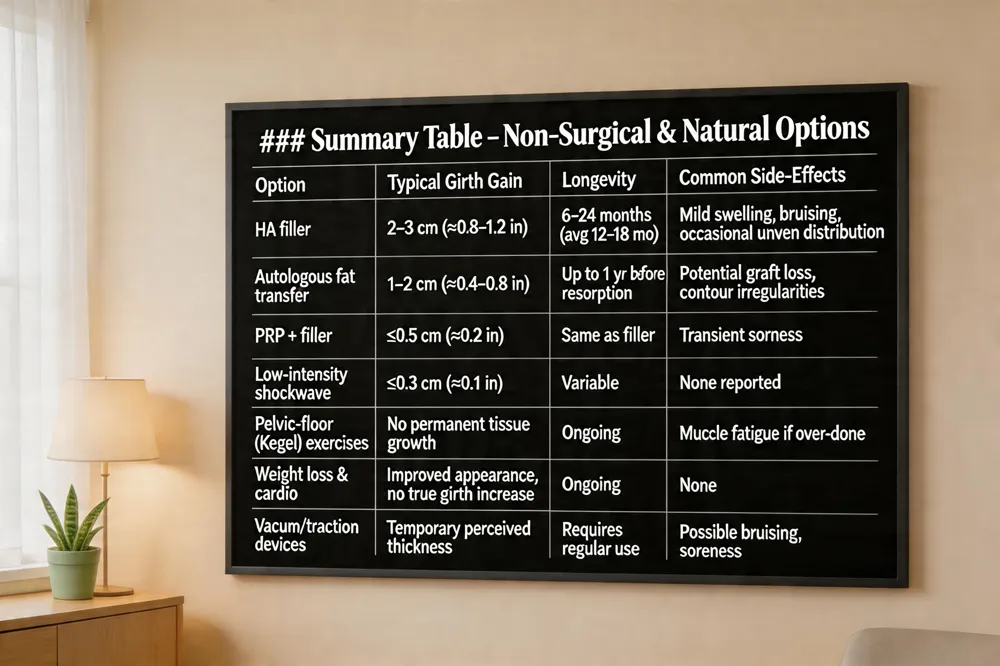 Penile girth can be enlarged without an incision by using injectable fillers, autologous fat transfer, adjunctive regenerative therapies, and targeted lifestyle measures.
Injectable fillers and their longevity – Hyaluronic‑acid (HA) HA fillers are the most studied. Prospective series of 19 men showed a mean flaccid girth gain of 3.3 cm (p < 0.001) with no complications and a safety profile limited to mild swelling, bruising, and occasional uneven distribution (21 %). Effects last 6‑24 months; repeat sessions are needed to maintain volume.
Autologous fat transfer – Fat harvested from the abdomen or thighs is injected into the subcutaneous penile shaft. Clinical data report gains of 1–2 cm with a more durable result than HA, though up to 30 % of the graft may resorb within a year.
Adjunctive therapies – Platelet‑rich plasma (PRP) and low‑intensity shockwave therapy stimulate tissue health and may modestly increase girth when combined with fillers.
Home‑based lifestyle measures – Regular pelvic‑floor (Kegel) exercises, weight loss to reduce pubic fat, and occasional use of vacuum or traction devices can improve perceived thickness and erectile rigidity.
Overall, non‑surgical options provide safe, reversible girth enhancement with rapid recovery and modest psychological benefits, especially when performed by board‑certified specialists.
Physiological and Psychological Impact
 Erection physiology and girth change: During an erection, blood fills the corpora cavernosa and the spongy tissue of the shaft, causing both length and circumference to expand. The average flaccid girth is about 3.7 inches (9.3 cm), while the erect girth rises to roughly 4.6 inches (11.7 cm). This natural thickening contributes to rigidity and varies among individuals.
Psychological benefits and self‑esteem: Studies of hyaluronic‑acid (HA) girth augmentation show that 47 % of men report increased self‑confidence and 42 % report heightened sexual pleasure after a statistically significant girth gain (average 3.3 cm). Reduced size‑related anxiety and improved body image can enhance intimacy, although broader measures of distress, self‑esteem, and quality of life often remain unchanged.
Potential side‑effects and risk mitigation: Complications such as infection, irregular contour, or nodules occur in a minority (≈1–8 %). Surgical grafts carry higher risks of scarring, sensation loss, and curvature. Proper patient selection, sterile technique, and adherence to postoperative abstinence (typically 14 days for fillers, 4‑6 weeks for grafts) mitigate these risks.
Does girth increase when you get hard? Yes, the penis becomes thicker when erect; blood fills spongy tissue, expanding circumference.
Penis enlargement side effects: Bruising, swelling, pain, infection, scarring, loss of sensitivity, curvature, nodules and, in severe cases, erectile dysfunction or deformity.
Penis enlargement foods: A diet rich in leafy greens, beets, citrus, omega‑3‑filled fish, watermelon, berries, pomegranate, nuts, avocado, and zinc‑rich foods supports vascular health, nitric‑oxide production, and testosterone balance, enhancing natural erectile function.
Implant and Surgical Solutions
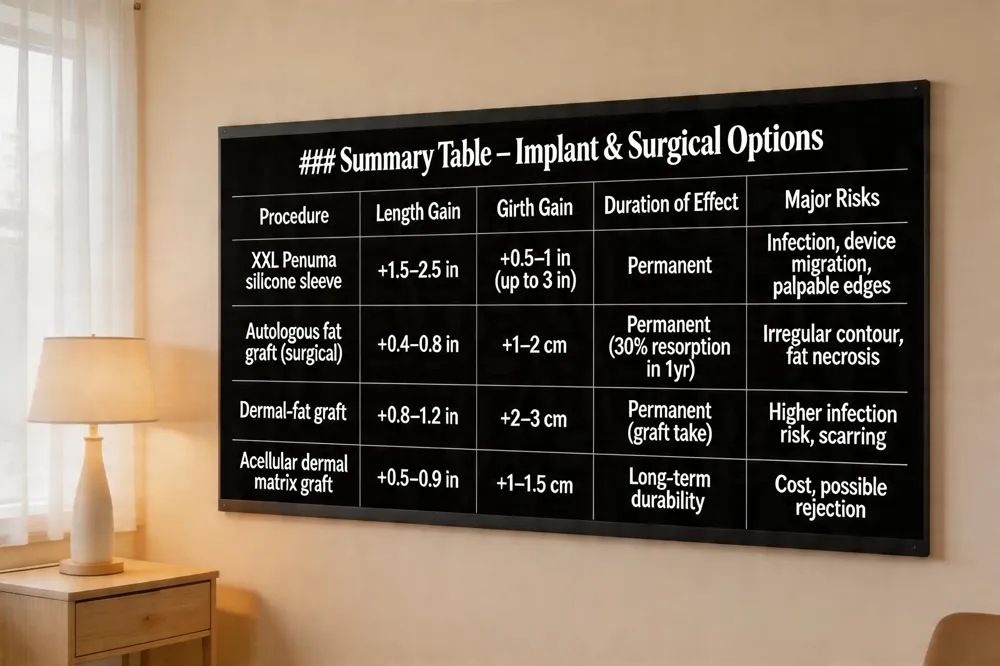 Penuma‑type implants, especially the XXL Penuma, are silicone sleeves placed under the penile skin to increase both length and girth. Clinical data show an average length gain of 1.5–2.5 inches, with some patients achieving up to 3 inches, and a girth boost of 0.5–1 inch. The device is inserted through a minimally invasive lateral scrotal or penile inversion approach, preserving the neurovascular bundle and allowing a natural‑looking result.
Surgical grafting techniques—including autologous fat transfer, dermal‑fat grafts, and acellular dermal matrix—provide permanent girth augmentation. Fat grafts typically add 1–1.5 cm, while dermal grafts can achieve 2–3 cm increases. These procedures require careful donor‑site harvesting, meticulous layering, and postoperative compression to reduce irregularities.
Long‑term outcomes are favorable when performed by board‑certified surgeons: most men retain at least 70 % of the gained girth after 12–24 months, and erectile function remains unchanged. Complication rates are low (≤5 %) for implants and grafts when aseptic technique and proper patient selection are observed.
How many inches does the XXL Penuma add? The XXL Penuma typically adds 1.5–2.5 inches in length and 0.5–1 inch in girth, with up to 3 inches possible depending on anatomy.
Real way to increase your size at home Pelvic‑floor (Kegel) exercises, weight control, cardiovascular fitness, and safe use of a vacuum‑expansion device can modestly improve erectile firmness and perceived size; permanent enlargement requires professional intervention.
Penis enlargement surgery near me Seek board‑certified plastic surgeons or urologists specializing in male genital enhancement—Dr. Victor Liu in the Bay Area offers discreet, personalized consultations and a full range of grafting and implant options.
Cost, Maintenance and Patient Experiences
 Financial considerations for hyaluronic‑acid (HA) girth enhancement vary widely. In the United States a typical treatment series—often 5–8 mL of filler administered over one to three sessions—costs between $4,800 and $7,200, reflecting $600–$1,200 per syringe, provider expertise, and geographic market. Some clinics offer lower‑range packages ($2,800–$4,400) when fewer syringes are needed or when a specific brand such as PhalloFill® is used. In addition to the procedural fee, patients should budget for consultation, ultrasound mapping, and post‑procedure care, which can add $200–$500.
HA fillers are temporary; most studies report durability of 12–18 months, with some formulations retaining up to 90 % of the gain at four years. Consequently, touch‑up injections are recommended every 12–24 months to maintain the desired circumference. The procedure is minimally invasive, allowing return to work the same day and sexual activity after 72 hours to one week, depending on the protocol.
Online patient reviews, especially on Reddit, echo these findings. Users frequently praise the immediate girth gain, natural feel, and rapid recovery, while also noting the high upfront cost and the need for periodic re‑injection. Satisfaction scores tend to be high when expectations are realistic and the procedure is performed by a board‑certified surgeon such as Dr. Victor Liu.
Frequently Asked Questions – Summary
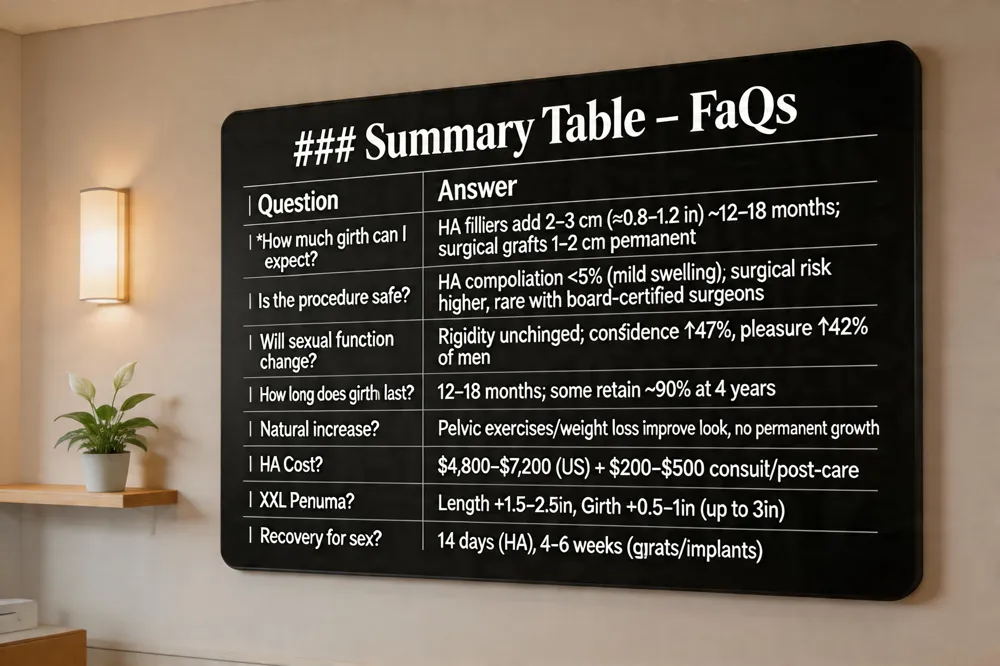
Quick reference for common concerns:
• How much girth can I expect? Injectable hyaluronic‑acid fillers typically add 2–3 cm (≈0.8–1.2 in) to flaccid girth, with gains lasting 12–18 months; surgical grafts can provide 1–2 cm permanent increases.
• Is the procedure safe? Complication rates for HA fillers are low (<5 % mild swelling, bruising, nodules). Surgical grafts carry higher infection and scarring risks. No serious adverse events were reported in the 19‑patient HA study.
• Will my sexual function change? Most studies show unchanged erectile rigidity (IIEF) but modest improvements in self‑confidence and sexual pleasure. 47 % of men reported increased self‑confidence; 42 % reported increased sexual pleasure.
Evidence‑based recommendations:
• Choose a board‑certified urologist or plastic surgeon experienced in penile aesthetics.
• Undergo psychological screening; men with untreated BDD may benefit from counseling before augmentation.
• Follow post‑procedure abstinence (14 days for HA fillers, 4–6 weeks for grafts) to minimize displacement and infection.
Next steps for interested patients:
- Schedule a consultation to discuss goals, anatomy, and realistic expectations.
- Review imaging (ultrasound duplex) to confirm vascular health.
- Decide on a minimally invasive filler (HA) or surgical graft based on desired durability and risk tolerance.
- Plan follow‑up visits for outcome assessment and possible touch‑up treatments.
Conclusion: Informed Choices for Enhanced Sexual Performance
Balancing expectations with clinical data is essential; most minimally invasive hyaluronic‑acid fillers produce a 2–3 cm girth gain and modest confidence boosts, while broader psychological benefits remain limited. Selecting a board‑certified urologist or plastic surgeon reduces complication rates, ensures proper injection planes, and allows evidence‑based postoperative counseling such as the 14‑day abstinence window. Future directions include combining regenerative therapies (PRP, shockwave) with fillers to improve tissue health, and developing validated,‑specific psychometric tools to capture long‑term satisfaction. Patients who prioritize realistic goals, safety, and ongoing follow‑up are best positioned to achieve lasting sexual confidence and functional outcomes.