

Understanding Minimally Invasive Girth Expansion
Minimally invasive girth augmentation refers to procedures that add volume to the penile shaft using small incisions, percutaneous injections, or sub‑cutaneous placement of biocompatible materials, thereby avoiding the extensive dissection of traditional open surgery. Patients often select these options because they promise shorter operative times, reduced anesthesia requirements, quicker return to daily activities, and a lower incidence of scar formation or sensory loss. The most common technologies today include autologous fat grafting, hyaluronic‑acid dermal fillers (e.g., Juvederm, PhalloFILL®), polymethyl‑methacrylate (PMMA) microspheres, and silicone‑based sub‑dermal implants such as the FDA‑cleared Penuma® sleeve. These agents are injected through a needle or placed through a tiny scrotal or infrapubic incision, allowing precise, 360‑degree coverage of the tunica albuginea. Safety advantages stem from limited tissue trauma, use of local anesthesia or mild sedation, and a typical recovery window of 1–2 weeks before normal activity, with most complications being mild edema, bruising, or transient sensory changes that resolve conservatively.
Injectable Fillers: Hyaluronic Acid, PMMA and the Himplant® Concept
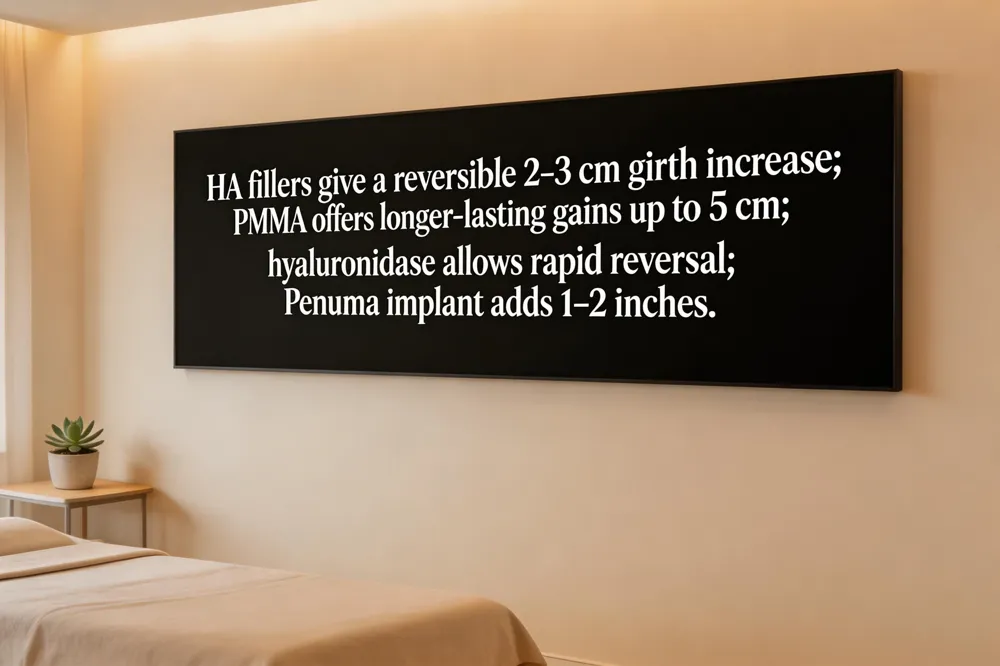
Hyaluronic acid (HA) is a naturally occurring polysaccharide that binds water, providing a soft‑tissue‑like augmentation that is biocompatible and reversible.
Micron‑sized PMMA microspheres (Bellafill) act as a long‑lasting scaffold; the collagen carrier dissolves while the spheres persist for years, stimulating collagen deposition for durable girth gains.
Procedurally, the penile shaft is marked, a high‑frequency ultrasound probe guides percutaneous injection into the sub‑dermal plane or directly under the tunica albuginea, and incremental volumes (≈15 ml HA or 10 ml PMMA) are distributed in a 360° fashion to avoid asymmetry. Immediate girth increase of 2–3 cm is typical; long‑term studies report 32 % circumference rise with HA and up to 5 cm (≈2 in) with PMMA at 12‑18 months.
Reversibility is a key advantage of HA: hyaluronidase can dissolve the filler within hours if over‑correction or adverse reaction occurs.
[Penuma implant] – a silicone sub‑cutaneous implant FDA‑cleared for aesthetic gain, expands mid‑shaft circumference from 8.5 cm to 13.4 cm (≈56 % increase) and yields high‑satisfaction rates (>80 %). Complications include seroma (4.8 %) and infection (3.2 %); device removal occurs in ≈3 % of cases.
How many inches does Himplant add? – patients typically gain 1–2 inches in girth, with a modest flaccid length increase of up to ½ inch, preserving natural erectile mechanics and sensation.
Autologous Fat Grafting and Emerging Tissue‑Engineered Scaffolds

Harvesting autologous fat for penile girth augmentation begins with low‑vacuum liposuction from the abdomen or thighs, followed by careful centrifugation and filtration to isolate viable adipocytes while discarding oil and blood. To maximize graft survival, surgeons over‑inject by 20‑30 % and employ a multi‑layer injection technique that distributes fat evenly beneath the tunica albuginea; postoperative compression and limited activity further reduce resorption. Emerging tissue‑engineered options include biodegradable PLGA (polylactic‑co‑glycolic acid) scaffolds seeded with a patient’s fibroblasts, which provide a structural matrix that integrates with native tissue and has shown girth gains of 2–3 cm in early series. Clinical reports indicate that autologous fat grafting00183-8/fulltext) typically adds 1–2 cm (0.4–0.8 in) to flaccid girth, though individual variability is high due to fat reabsorption. Complications are generally mild—bruising, transient edema, or occasional nodules—and are managed with observation, antibiotics for infection, and revision grafting if needed.
How many inches does enlargement surgery add? Penuma® silicone implant surgery usually yields 1–2 inches of flaccid length gain, with mid‑shaft girth expanding from ~8.5 cm (3.3 in) to ~13.4 cm (5.3 in), a ~56 % increase; permanent changes are achieved with low complication rates (<5 %).
How to increase girth size permanently? Permanent girth enhancement is most reliably achieved through medically supervised procedures such as the Penuma® silicone implant or injectable hyaluronic‑acid fillers (e.g., PhalloFill®) that provide lasting volume after a series of treatments. Non‑surgical “home” methods lack scientific support and may cause injury; therefore, consultation with a board‑certified specialist ensures safe, anatomy‑based, and realistic outcomes.
Silicone Sleeve Implants and the Gold‑Standard Choice

Best male enlargement surgery: The Penuma® implant is regarded as the gold‑standard for penile enlargement due to its FDA clearance, customizable sizing, and proven safety profile. Dr. Victor Liu’s expertise ensures precise placement and optimal aesthetic outcomes.
Penis enlargement side effects: Procedures can cause bleeding, hematoma, anesthesia reactions, seroma (≈5 %), scar formation (≈4‑5 %), infection (≈3 %), altered sensation, or implant removal in severe cases. Dr. Victor Liu emphasizes thorough evaluation and postoperative care to minimize risks and achieve natural‑looking results.
Tunica Albuginea Expansion (TEP) and Ligamentolysis Explained
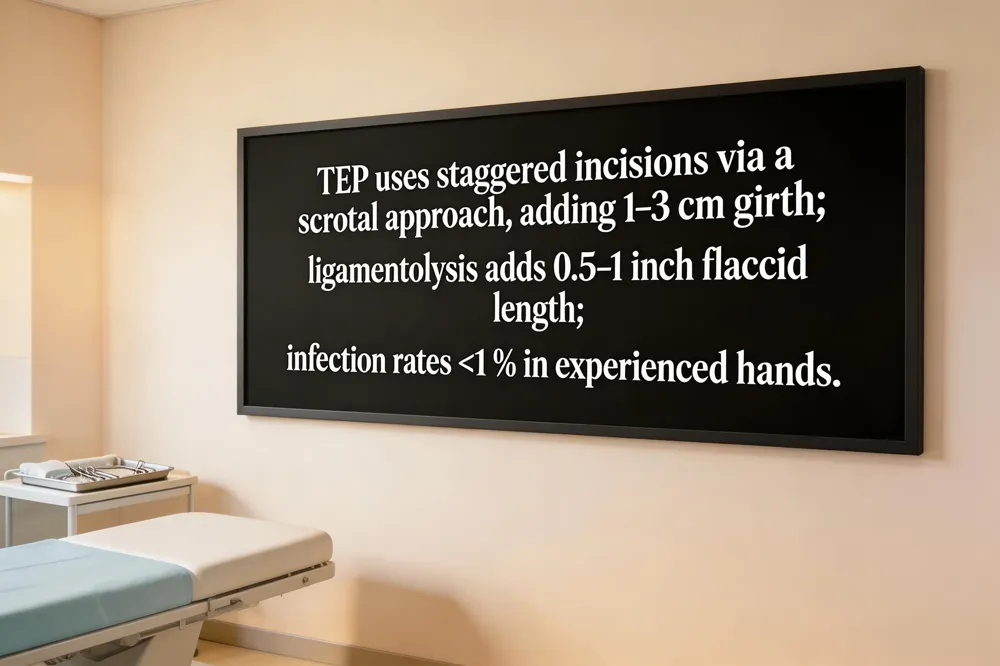
The Tunica Albuginea Expansion (TEP) technique uses a series of 2–3 mm staggered incisions—vertical for length preservation and horizontal for girth gain—made through a single 3‑cm scrotal incision. This scrotal approach avoids circumcision, reduces cosmetic concerns, and shortens operative time (2–3 hours) compared with traditional penile‑circumferential exposure. When combined with suspensory ligament release (ligamentolysis), the penile shaft can be lengthened in the flaccid state while the TEP incisions maintain or augment girth, creating a synergistic effect that improves both dimensions. Clinical series report average length increases of 1.3 ± 0.9 cm (up to 2.4 cm when paired with lipoplasty) and girth gains of 1–3 cm, with low complication rates (infection < 1 % in experienced hands).
Ligamentolysis surgery – This procedure severs the suspensory ligament, allowing more shaft to hang outside the pubic bone. Performed under local or general anesthesia via a small base‑of‑penis incision, it yields an apparent flaccid gain of 0.5–1 inch. Recovery involves 2–3 weeks of limited activity; swelling resolves within weeks and sensation returns gradually.
Suspensory ligament surgery cost – In the U.S., the procedure typically ranges from $3,000 to $8,000, excluding additional implants (e.g., Penuma) that can add $2,000–$5,000. Insurance rarely covers cosmetic releases, so patients should anticipate out‑of‑pocket expenses of $5,000–$12,000 at specialized centers such as Dr. Victor Liu’s practice.
Comprehensive Treatment Planning and Patient Selection

A thorough medical and psychological screening is the first step in every penile enhancement program. Patients complete a health questionnaire, laboratory work‑up, and a validated anxiety or body‑dysmorphia assessment to rule out Small Penis Anxiety or untreated psychiatric conditions, which can predict postoperative dissatisfaction.
Based on anatomy, erectile function, and patient goals, we tailor surgical versus minimally invasive options. Candidates with normal erections may choose the FDA‑cleared Penuma® silicone implant or tunica albuginea expansion (TEP) for permanent girth and modest length gains, while men preferring reversible results often receive hyaluronic‑acid fillers such as PhalloFill® or the Diamond XL 360 protocol.
Counseling and realistic expectation management are integral; we discuss typical gains (1–3 cm girth, 1–2 cm length), recovery timelines, and potential complications (seroma, asymmetry, sensory change).
Adjunct therapies—PRP to improve graft survival, testosterone optimization for erectile health, and structured post‑procedure rehabilitation—are offered when indicated.
All procedures aim for a natural‑looking shaft, using ultrasound‑guided injections or small‑incision techniques that preserve neurovascular bundles and minimize scarring.
Penis enlargement treatment – Our clinic combines state‑of‑the‑art surgical (Penuma® implant, TEP) and non‑surgical (HA fillers, PhalloFill® options, personalized through advanced imaging and strict pre‑operative assessment to ensure safety, natural aesthetics, and high patient satisfaction.
What is a good size for a guy in inches? – Scientific data show the average erect length is 5.1–5.5 inches (13–14 cm) with a normal range of 4–7 inches. This interval supports comfortable penetration and sexual function. Size concerns are best addressed with counseling, realistic expectations, and, when appropriate, minimally invasive enhancement rather than focusing on a specific “ideal” measurement.
Non‑Surgical Myths, Jelqing and Real‑World Evidence

Most advertised pills, lotions, and “natural” supplements lack any peer‑reviewed data supporting permanent penile enlargement; studies show they can cause irritation or permanent tissue damage.
Mechanical traction devices and vacuum pumps have been studied in controlled trials.
Traction therapy yields modest length gains of 1–2 cm after months of daily use, but girth changes are negligible; vacuum pumps temporarily increase girth through engorgement but do not produce lasting volume.
Aggressive manual stretching, such as jelqing, applies repetitive force to delicate tissue.
Clinical experience reports micro‑tears, bruising, fibrosis, and rare vascular injury, potentially compromising erectile function.
Urology societies (AUA, Sexual Medicine Society of North America) advise that non‑surgical methods are investigational and should not be first‑line treatments; they recommend counseling and realistic expectations.
Safe alternatives include FDA‑cleared hyaluronic‑acid fillers (e.g., PhalloFILL® or the Penuma silicone sleeve implant, both performed by board‑certified surgeons with documented girth gains and high satisfaction.
Patients should prioritize evidence‑based options and avoid unproven techniques.
Financial Planning, Costs and Post‑Procedure Care

Understanding the financial landscape of penile enhancement helps patients make informed decisions. Breakdown of fees – Injectable fillers such as hyaluronic‑acid PhalloFill® typically cost $2,800–$4,400 per session, depending on volume and desired gain; the regenerative P‑Shot ranges from $1,800–$2,500. Surgical options, notably the FDA‑cleared Penuma® silicone implant, are priced higher, often $12,000–$18,000 including anesthesia, facility fees, and postoperative care. Financing and insurance – Most clinics, including Dr. Victor Liu’s practice, offer flexible financing plans, interest‑free installments, and bundled packages that reduce upfront costs. Insurance rarely covers cosmetic augmentation, but certain medical indications (e.g., micropenis) may qualify for reimbursement. Follow‑up and long‑term maintenance – Non‑surgical patients should schedule visits at 1 week, 1 month, and 6 months to monitor filler retention and address any nodules; surgical patients typically have a 2‑day drain removal, a 2‑week wound check, and a 3‑month imaging visit. Geographic impact – Pricing varies by region; metropolitan centers (NY, LA, Miami) command higher fees than smaller markets, reflecting overhead and demand. Value of comprehensive care packages – Integrated programs that combine pre‑operative counseling, the, procedure, and post‑procedure support often deliver better outcomes and lower overall cost per quality‑adjusted gain. This holistic approach ensures safety, realistic expectations, and sustained patient satisfaction.
Your Path to Safe, Natural Enhancement
Current clinical data support several minimally invasive girth‑enhancement methods that balance effectiveness with safety. Hyaluronic‑acid dermal fillers, such as those used in the Diamond XL 360 and PhalloFILL® protocols, provide immediate volume gains of 2–3 cm and are reversible with hyaluronidase; autologous fat grafting offers a natural feel with average increases of 2–3 cm, although some reabsorption is expected. Both techniques are performed under local anesthesia, require no large incisions, and allow rapid return to daily activities. Our practice is led by board‑certified urologists and plastic surgeons who tailor each plan to the patient’s anatomy, health status, and aesthetic goals, ensuring realistic expectations and optimal outcomes. Interested men should schedule a confidential consultation, complete a comprehensive medical and psychological evaluation, and discuss individualized treatment pathways and financing options, and post‑procedure support for long‑term satisfaction and confidence.