

Understanding Scrotal Asymmetry
Scrotal asymmetry arises from a variety of benign and pathological sources. Common causes include congenital differences in testicular size, excess redundant skin from aging, hydrocele or varicocele‑related swelling, prior surgeries, trauma, and localized fat deposits. The resulting uneven contour can produce physical discomfort during sports, bicycling, or intercourse and may lead to chronic chafing, urinary irritation, and heightened self‑consciousness that diminishes confidence and sexual satisfaction. Surgical correction is generally advised when the asymmetry is medically significant—e.g., causing pain, functional impairment, or recurrent skin irritation—or when the patient’s psychological distress outweighs the risks. Indications include painful scrotal sagging, penoscrotal webbing that interferes with sexual activity, or post‑procedure scarring that limits comfort. In these cases, scrotoplasty (scrotal reduction or lift) or adjunctive procedures such as testicular prosthesis placement can restore a natural‑looking, symmetrical scrotum, improve comfort, and enhance overall self‑esteem.
Surgical Options Overview

Scrotoplasty (scrotal lift) is a reconstructive procedure that removes excess skin, tightens the dartos muscle, and reshapes the scrotal sac to treat buried or webbed penis, scrotal sagging, trauma‑related loss, or lymphedema. Performed by a board‑certified urologist or plastic surgeon such as Dr. Victor Liu under general or local anesthesia, the operation typically lasts 30–60 minutes, uses dissolvable sutures, and may include a drain. Benefits include reduced discomfort, improved hygiene, better cosmetic proportion, and heightened self‑esteem; most patients resume light activities within two weeks and sexual activity after 2–3 weeks. Risks—infection, bleeding, temporary sensation changes—are discussed during pre‑operative counseling.
Scrotal reconstruction addresses larger defects using techniques such as scrotal advancement flaps and split‑thickness skin grafts, or medial/anterior thigh flaps. Choice depends on defect size, patient health, and aesthetic goals, aiming for natural appearance while preserving testicular temperature regulation. Hospital stay is brief (often outpatient) and full healing occurs over 2–4 weeks.
Patient candidacy requires realistic expectations, a thorough medical evaluation, and motivation for functional or cosmetic improvement. Candidates include men with pain after varicocele/hydrocele surgery, chronic irritation from sagging skin, or asymmetry after trauma. Pre‑operative counseling emphasizes achievable results, postoperative support garments, activity restrictions, and follow‑up to monitor healing and sexual well‑being.
Scrotoplasty Procedure Details and Recovery

Scrotoplasty (scrotal lift) is performed in an outpatient setting under either general anesthesia or a local/twilight block with the patient awake. The surgeon makes a discreet incision near the penis‑scrotum junction or along the natural raphe, excises excess skin and subcutaneous tissue, tightens the dartos muscle, and closes the wound with dissolvable sutures; a drain may be placed to reduce swelling. Post‑operative pain is usually mild to moderate and is controlled with over‑the‑counter acetaminophen or ibuprofen, supplemented by cold compresses for 20‑minute intervals during the first 3‑4 days. Swelling and bruising resolve within the first week, and patients are advised to wear a supportive garment for 1‑2 weeks, limit heavy lifting, and abstain from sexual activity for 2‑3 weeks. Benefits include improved comfort, hygiene, and self‑esteem, while risks such as infection, bleeding, or temporary sensory change are discussed during pre‑operative counseling.
Finding a Scrotal Lift Near You and Cost Considerations

Scrotal lift near me – To locate a scrotal lift close to you, seek a board‑certified plastic surgeon or urologist who specializes in male genital aesthetics. In the Bay Area, Dr. Victor Liu, a double‑board‑certified plastic surgeon, offers personalized, minimally invasive scrotal lift procedures performed in a state‑of‑the‑art center. His technique uses discreet incisions, dissolvable sutures, and optional drains to achieve a natural‑looking, lifted scrotum with rapid outpatient recovery. Schedule a private consultation to discuss candidacy, anatomy, and goals.
Scrotal lift surgery cost – The typical United States price range for scrotal lift (scrotoplasty) is $3,000‑$8,500, varying by surgeon expertise, facility, and tissue removal extent. Dr. Liu’s practice generally bills $4,500‑$7,500, covering the surgeon, anesthesia, facility fees, and post‑op follow‑up. Insurance rarely covers purely cosmetic lifts; financing plans are available to offset out‑of‑pocket expenses.
Scrotal lift before and after – Pre‑operative patients often present with excess, sagging scrotal skin causing discomfort and self‑consciousness. Post‑operative results show tighter, firmer, and more elevated scrotal tissue with a smooth contour, preserved testicular function, and minimal scarring. High‑resolution before‑and‑after images from Dr. Liu’s clinic demonstrate consistent, natural outcomes across diverse patients.
Implant Options and Testicular Prostheses

Scrotal reconstruction can be enhanced with prosthetic devices when tissue loss or atrophy is present. Two common implant strategies are the wrap‑around technique, which encircles a native testicle with a hollow prosthesis, and the side‑by‑side (displacement) method, which places a solid implant adjacent to the existing gland to increase bulk.
Wrap‑around Testicle Implant
A wrap‑around implant is a custom‑designed prosthesis that surrounds the natural testicle, using a hollow central chamber that accommodates the spermatic cord. This approach preserves the native organ while adding volume, reduces the risk of migration, and yields a natural‑looking contour when performed by an experienced surgeon such as Dr. Victor Liu.
Cost and Insurance Coverage
The prosthesis itself typically costs $2,500–$3,000 (FDA‑approved saline‑filled Torosa™) with total procedural fees ranging $4,000–$8,000 for a single implant; bilateral placement roughly doubles the expense. Wrap‑around devices are slightly more expensive ($4,000–$6,000), but many private insurers cover the implant when medically necessary after loss of a testicle. Choosing an outpatient center and local anesthesia can further lower out‑of‑pocket costs.
Patient Satisfaction and Outcomes
Across multiple studies, 80‑90% of men report high satisfaction after prosthesis placement, citing improved body image and confidence. Complication rates are low (≈2% extrusion, <1% infection). Proper sizing, realistic expectations, and thorough pre‑operative counseling are key to achieving optimal aesthetic and functional results.
Penile Enlargement: Terminology, Effectiveness, and Safety

Penis enlargement surgery name
Penis enlargement surgery is most commonly called phalloplasty. It is also referred to as penile augmentation, penile enlargement surgery, or surgical male enhancement. The procedure can involve lengthening techniques such as suspensory ligament release, girth‑increasing methods like fat grafting or dermal fillers, or the placement of penile implants. In clinical practice, surgeons often specify the exact method—e.g., “phalloplasty with fat grafting” or “phalloplasty with a Penuma implant”—to clarify the intended outcome. All of these terms describe the same category of procedures aimed at permanently increasing penis size.
Does penis enlargement surgery work
Penile enlargement surgery can produce measurable gains in length or girth, especially when using FDA‑cleared implants such as the Penuma, which have documented average increases of 1–2 inches in girth and 0.5–1 inch in flaccid length. However, results are highly individual, and many patients experience only modest changes or no change at all. The procedures carry risks—including infection, scarring, altered sensation, and, in rare cases, erectile dysfunction—so they are generally reserved for men with medical conditions like micropenis or a buried penis rather than purely cosmetic concerns. Non‑surgical options (pills, pumps, traction devices) have little scientific support and can sometimes cause harm. Overall, while penis enlargement surgery can work for some men, its effectiveness is not guaranteed, and the decision should be made after a thorough evaluation of benefits, risks, and realistic expectations.
Penis enlargement surgery side effects
Penis enlargement surgery commonly causes postoperative swelling, bruising, and pain that usually resolve within a few weeks. Infection and wound‑healing problems can arise, especially if the procedure involves implants or fat grafting, leading to redness, drainage, or the need for antibiotics. Many patients experience altered sensation, ranging from numbness to heightened sensitivity, and in some cases the implant or graft may shift, causing asymmetry or migration. More serious complications include scar tissue formation, penile curvature, deformity, or shortening that can impair sexual function. Although rare, severe outcomes such as non‑healing wounds, subcutaneous masses, and the need for additional corrective surgeries may occur.
Best male enlargement surgery
The most effective male enlargement surgery is a personalized, FDA‑cleared penile implant that combines safety with natural‑looking results. For men seeking purely cosmetic gain, the Penuma® or Himplant® soft‑silicone implants are the only FDA‑cleared options that add 1–2 inches of girth and up to 2 inches of flaccid length without compromising sensation. When erectile dysfunction is also present, a three‑piece inflatable prosthesis (Coloplast Titan or AMS 700) can be sized to preserve or increase length while restoring rigidity. All procedures are performed outpatient through a minimal incision, with a recovery time of a few days and a high satisfaction rate reported by both patients and partners. Consulting with a board‑certified plastic surgeon such as Dr. Victor Liu ensures the implant is contoured to your anatomy and that you receive the most advanced, minimally invasive technique available.
Penis enlargement tablet
Penis‑enlargement tablets are marketed as a quick fix, but no FDA‑approved product has been shown to increase length or girth in a scientifically reliable way. Clinical studies consistently find little to no measurable benefit, and many formulations contain unlisted or unsafe ingredients that can cause hormonal imbalance, cardiovascular strain, or allergic reactions. Because the evidence base is weak, reputable physicians—including double‑board‑certified plastic surgeon Dr. Victor Liu—do not recommend these pills as a primary treatment for size concerns. Instead, a thorough evaluation can identify underlying conditions such as hormonal deficiencies or Peyronie’s disease that may be addressed with proven therapies. For men seeking safe, lasting results, personalized, minimally invasive options performed by a qualified specialist remain the most effective route.
Post‑Operative Support and Activity Restrictions
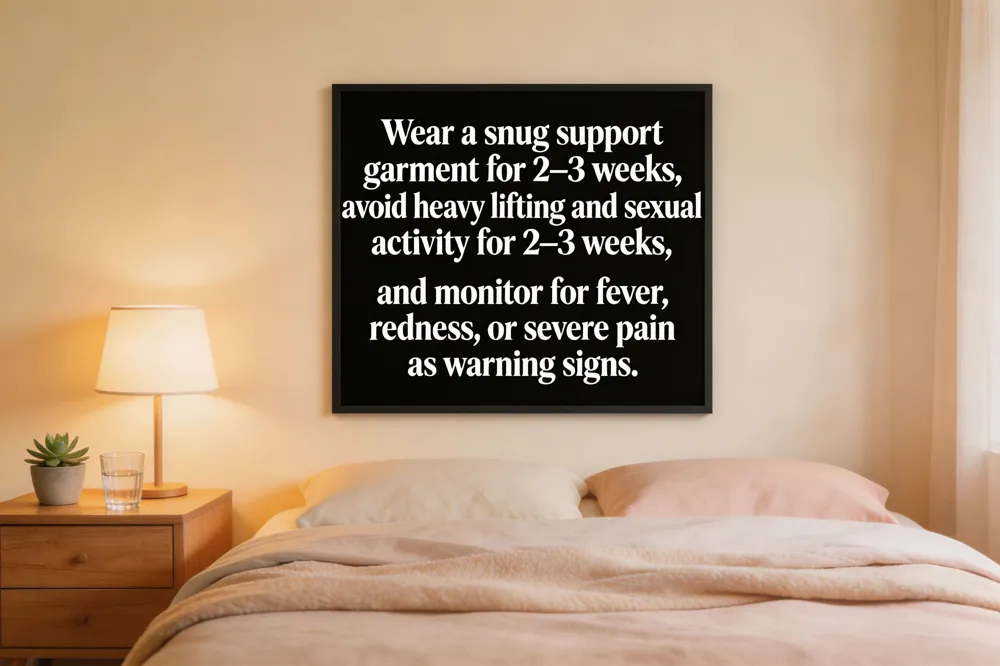
After scrotal or testicular surgery, proper support and activity restriction are essential for optimal healing. Patients should wear a snug, breathable support garment—such as a jockstrap or compression boxer—for the first 2–3 weeks, keeping the scrotum gently elevated while allowing airflow. The garment must be tight enough to limit movement but not so tight as to impair circulation; it can be removed briefly for hygiene as directed by the surgeon. Ambulation is encouraged within the first 24 hours, but heavy lifting, vigorous exercise, and sexual activity should be avoided for at least 2–3 weeks (longer after extensive reconstruction). Return to work usually occurs after 1–2 days, while more demanding jobs may require 1–2 weeks. Warning signs that merit immediate medical attention include fever >101 °F, increasing redness, pus, swelling larger than a tennis ball, severe pain, or difficulty urinating. Prompt reporting of these symptoms helps prevent infection, hematoma, or wound dehiscence. Follow‑up visits at 1 and 4 weeks allow the surgeon to assess healing, remove drains, and adjust support if needed.
Pediatric and Infertility‑Related Scrotal Surgery

Orchiopexy/treatment) is the standard repair for undescended testicles (cryptorchidism) and torsion. Performed between 6 and 24 months, a small groin or scrotal incision (often laparoscopic) secures the testicle in the scrotum. Outpatient discharge is typical; pain is mild, and normal activity resumes within 1–2 weeks, avoiding straddle toys. Follow‑up at 10–14 days and four months confirms positioning.
Varicocelectomy treats infertility from dilated pampiniform veins. Microscopic or laparoscopic ligation improves testicular temperature and often raises sperm count within weeks. The 45–60 minute procedure uses general or regional anesthesia, and patients return to light duties after one week.
Orchiectomy, required for cancer, trauma, or gender‑affirming care, removes the testicle via an inguinal or scrotal incision. Hormone replacement may be needed, and many surgeons place a silicone prosthesis (e.g., Coloplast Torosa™ in the same session to preserve symmetry. Recovery is rapid; most men resume activities within a week.
These procedures, performed by board‑certified surgeons such as Dr. Victor Liu, follow evidence‑based protocols that minimize complications and optimize functional and aesthetic outcomes.
Key Takeaways and Next Steps
A personalized evaluation is the foundation of any successful scrotal or male‑enhancement procedure. During the initial consultation, the surgeon reviews your medical history, performs a focused physical exam, and may order imaging (ultrasound or MRI) to rule out underlying pathology such as hydrocele, varicocele, or scar tissue. This assessment determines whether a scrotal lift, scrotal reduction, tissue graft, or prosthetic implantation is appropriate and helps set realistic aesthetic and functional goals.
Safety and natural results are top priorities. All techniques—whether local‑anesthesia skin excision, Z‑plasty, muscle tightening, or flap reconstruction—are performed by board‑certified plastic surgeons experienced in genital aesthetics, using absorbable sutures, meticulous hemostasis, and postoperative protocols that include scrotal support, ice therapy, and activity restrictions to minimize complications such as infection, hematoma, or sensory changes.
If you are ready to discuss your concerns and explore a tailored surgical plan, contact Dr. Victor Liu for a confidential, private consultation. He will guide you through the options, expected recovery timeline, and insurance considerations, ensuring a discreet, safe, and satisfying outcome.