

Why Metrics Matter in Male Enhancement
Patient‑reported outcome measures (PROMs) such as the International Index of Erectile Function (IIEF), the Erectile Dysfunction Inventory of Treatment Satisfaction (EDITS), and the Rosenberg Self‑Esteem Scale give clinicians a direct window into how men perceive changes in sexual function, confidence, and quality of life after an enhancement procedure. Objective clinical data—precise pre‑ and post‑procedure measurements of flaccid girth, erect length, and erectile hardness (EHS) scores—provide the anatomical anchor that validates those subjective reports. Industry benchmarks (e.g., ≥85 % overall satisfaction for minimally invasive fillers, 60–80 % for surgical grafts, and >90 % for penile implants) allow clinics to compare outcomes against national standards and identify gaps in care. The use of validated questionnaires (BDDQ, MINI‑BDD, K10, BIQLI) ensures that psychological variables such as body‑image distress and dysmorphia are systematically captured, preventing missed diagnoses and supporting holistic treatment planning. Together, these metrics create a robust, evidence‑based framework that drives patient safety, optimizes satisfaction, and guides continuous quality improvement in male enhancement services.
Key Findings on Male Penile Enhancement
- HA filler injections reported zero major complications in a prospective cohort of 19 men, with only 21% noting aesthetic concerns about filler distribution.
- Penuma silicone implants had a 12% seroma rate, 3% infection rate (all with infrapubic incisions), and a 5% erosion rate; revision surgery was more common with the infrapubic approach.
- Inflatable penile prostheses showed overall complication rates of 9% for major events (infection, erosion, mechanical failure) and 31% for minor events (pain, superficial wound breakdown).
- Patient-reported confidence increased in 47% of HA filler recipients and sexual pleasure was reported as improved by 42% of the same group.
- In a retrospective review of 92 Penuma patients, 82% were satisfied or very satisfied with postoperative appearance, and 75% said they would choose the surgery again.
- Large multicenter studies of penile prostheses report average EDITS scores of 75 ± 23 and overall satisfaction rates ranging from 89% to 94%.
- Self‑discrepancy scores improved markedly after HA filler (Cohen’s d = 0.85), and the prevalence of Body Dysmorphic Disorder fell from 11% pre‑procedure to 0% at six‑month follow‑up.
- HA filler increased flaccid girth by 3.29 cm (Cohen’s d = 2.13); Penuma implants added an average of 2.5 cm to flaccid length and 3.1 cm to girth.
- The primary motivations for seeking enlargement are self‑confidence (≈ 47%) and enhanced sexual pleasure (≈ 42%).
- Penuma implant costs range from $8,000 to $12,000 and are typically not covered by insurance, whereas HA filler offers a low‑risk, reversible alternative.
1. Complication Rates Across Enhancement Options

HA filler safety profile – In a prospective cohort of 19 men receiving hyaluronic‑acid (HA) penile girth augmentation, No complications reported among the 19 participants during a six‑month follow‑up. This aligns with systematic reviews that rank HA fillers as having lower complication rates than older injectable materials such as paraffin, mineral oil, or silicone. The most frequent negative impact was aesthetic (21 % reported aesthetic concerns about filler distribution), but no infections, pain, or sensory changes were documented.
Penuma and Himplant surgical complications – Retrospective data on 92 Penuma recipients showed a 12 % overall seroma rate, a 3 % infection rate (all in the infrapubic approach), and a 5 % erosion incidence. Revision surgery was required more often with the infrapubic incision (13 % vs 2 % for the lateral scrotal approach). While functional gains (average flaccid girth +3.1 cm, length +2.5 cm) were statistically significant, the higher revision and removal rates highlight the importance of incision choice and meticulous technique.
Implant infection and revision statistics – Large multicenter series of inflatable penile prostheses report overall complication rates of 9 % for major events (infection, erosion, mechanical failure) and 31 % for minor events (pain, superficial wound breakdown). Major complications dramatically reduce satisfaction (only 54 % of men with a major complication remained satisfied versus 80 % without). Revision surgery occurs in roughly 10‑15 % of cases, most commonly for infection or mechanical failure.
Adverse‑event monitoring – Across all modalities, clinics employ validated patient‑reported outcome measures (PROMs) such as the EDITS, IIEF, and PSQ‑18, coupled with objective safety metrics (infection, seroma, device failure). Routine electronic health‑record alerts, scheduled 1‑, 3‑, 6‑, and 12‑month follow‑ups, and systematic complication tracking enable early identification of issues and support continuous quality improvement.
Overall, HA filler injections demonstrate the most favorable safety profile, while surgical options—Penuma implants and penile prostheses—carry higher rates of infection, seroma, and revision, underscoring the need for thorough pre‑operative counseling and diligent postoperative monitoring.
2. Patient Satisfaction Scores and Their Drivers

Patient‑reported outcome measures (PROMs) have become the cornerstone for evaluating male‑enhancement procedures, allowing clinics to quantify both objective gains and subjective well‑being.
Self‑confidence and sexual pleasure after hyaluronic‑acid (HA) filler. In a prospective cohort of 19 men who received nonsurgical HA penile girth augmentation, 47 % reported a notable boost in self‑confidence and 42 % described increased sexual pleasure for themselves or their partners. The mean flaccid girth rose by 3.29 cm (from 9.50 cm to 12.79 cm) six months post‑procedure (p < 0.001, Cohen’s d = 2.13) with zero complications, underscoring that aesthetic improvement can translate into measurable psychosocial gains even when broader distress scores (K10, RSES, BIQLI) remain statistically unchanged.
Penuma silicone implant satisfaction. A retrospective review of 92 patients undergoing Penuma silicone implant reported that 82 % were satisfied or very satisfied with postoperative penile appearance, and 75 % said they would repeat the surgery. Relationship dissatisfaction fell from 55 % pre‑operatively to 18 % post‑operatively, while self‑confidence regarding size jumped from 7 % very satisfied pre‑procedure to 91 % satisfied or very satisfied after surgery. Complication rates were low (infection 3 %, seroma 12 %, erosion 5 %), suggesting that a minimally invasive, well‑executed device can drive high satisfaction.
Implant satisfaction benchmarks (EDITS, PSQ‑18). Large multicenter studies of penile prostheses consistently show EDITS scores averaging 75 ± 23 and overall satisfaction rates of 89 %–93.8 %. In a Jordanian series, early complications markedly reduced EDITS scores (p = 0.001). Non‑surgical urology clinics using the RAND Patient Satisfaction Questionnaire‑18 (PSQ‑18) achieve a 65 % overall satisfaction rate, with wait‑time and communication emerging as the strongest predictors of lower scores (wait > 60 min, OR = 0.25; lack of interpreter, OR = 0.29).
Impact of communication and counseling. Across multiple studies, clear pre‑procedure counseling and realistic expectation setting are repeatedly linked to higher PROM scores. Clinics that provide detailed education, visual simulations, and personalized treatment plans report superior satisfaction, whereas inadequate counseling correlates with aesthetic concerns (21 % in HA filler users) and lower net promoter scores. Integrating structured counseling into the care pathway is therefore essential for maximizing patient‑reported outcomes in both surgical and nonsurgical male‑enhancement settings.
3. Psychological Outcomes: BDD, Distress, and Body Image

Across the same interval, broader measures of psychological well‑being showed stability rather than dramatic change. Scores on the Kessler Psychological Distress Scale (K10) shifted from a mean of 14.74 (SD = 3.89) pre‑procedure to 14.32 (SD = 3.70) post‑procedure (t = 0.47, p = 0.64, Cohen’s d = 0.11), indicating a negligible effect. Self‑esteem, assessed by the Rosenberg Self‑Esteem Scale, rose modestly from 22.11 (SD = 5.45) to 23.79 (SD = 6.00) (t = ‑1.93, p = 0.07, d = 0.29), a non‑significant trend toward improvement. Body‑image‑related quality of life (BIQLI) increased from 0.61 (SD = 1.55) to 1.19 (SD = 1.34) (t = ‑1.32, p = 0.21, d = 0.40), again without statistical significance.
A more pronounced psychological shift was observed in the self‑discrepancy domain. Participants’ perceived actual penile girth moved from below‑average to above‑average (percentile ≈ 59.8) after augmentation, and the gap between actual size and the “should‑be” or “ideal” size narrowed significantly (t = ‑3.28, p = 0.004, d = 0.85). This large effect size reflects a meaningful reduction in the cognitive‑emotional conflict that often fuels dissatisfaction.
Interpreting these effect sizes, a Cohen’s d ≥ 0.8 (as seen for self‑discrepancy) denotes a strong practical impact, whereas d ≈ 0.1–0.4 for distress, self‑esteem, and BIQLI signals small to modest changes. Clinicians should therefore emphasize that while girth augmentation can substantially lessen size‑related self‑discrepancy and BDD symptoms, broader psychological distress and self‑esteem may require adjunctive support such as counseling or psychotherapy to achieve optimal overall well‑being.
4. Demand for Larger Penis Size: Survey Insights

Nonsurgical interventions, particularly hyaluronic‑acid (HA) filler injections, have gained traction because systematic reviews report lower complication rates and higher satisfaction compared with older injectable materials (e.g., paraffin, silicone).
In a prospective cohort of 19 men receiving HA girth augmentation, the Nonsurgical HA penile girth augmentation increased flaccid girth by 3.29 cm (‑ 9.50 cm to 12.79 cm) six months post‑procedure, with No complications reported among the 19 participants. The procedure’s minimally invasive nature and rapid recovery have driven demand among men who prefer a reversible, low‑risk alternative to surgery.
Motivation for enlargement is dominated by psychosocial factors. Across multiple studies, nearly half of participants (≈ 47 % cited improved self‑confidence as the primary driver, while 42 % reported heightened sexual pleasure for themselves or their partners.
Body‑image concerns are also prominent; men often perceive a gap between their actual size and an “ideal” or “should‑be” size. This self‑discrepancy diminishes after augmentation, particularly for girth and non‑erect length, suggesting that the procedure can partially align perceived and actual dimensions.
Screening for Body Dysmorphic Disorder (BDD) reveals a noteworthy link between size‑related dissatisfaction and underlying psychopathology. In the HA‑augmentation study, 11 % of men met BDD criteria pre‑procedure, a prevalence that fell to zero at six‑month follow‑up, indicating that successful augmentation may alleviate some dysmorphic symptoms.
However, broader surveys of men seeking enhancement consistently show elevated COPS‑P scores and lower Rosenberg self‑esteem compared with non‑clinical controls, underscoring the need for thorough psychological assessment before any intervention.
Overall, the data paint a clear picture: a sizable, psychologically nuanced segment of men desires penile enlargement, with a growing preference for safe, minimally invasive nonsurgical solutions that promise tangible gains in girth, self‑confidence, and sexual satisfaction.
5. Objective Clinical Gains: Length and Girth Increments

Objective measurements of penile size before and after enhancement procedures provide a concrete basis for evaluating clinical success. In a prospective study of 19 men who received nonsurgical hyaluronic acid (HA) filler for girth augmentation, the Nonsurgical HA penile girth augmentation increased flaccid girth by 3.29 cm – a mean gain from 9.50 cm to 12.79 cm. The change was statistically significant (paired t‑test t = ‑7.50, p < 0.001) with a very large effect size (Cohen’s d = 2.13). No complications reported among the 19 participants, and 47 % reported increased self‑confidence after the procedure while 42 % reported increased sexual pleasure for themselves or their partners.
For surgical augmentation, the Penuma silicone subcutaneous penile implant increased flaccid penile length by 2.5 cm and flaccid girth by 3.1 cm – a mean increase of 44 % in length and 32 % in girth in a retrospective cohort of 92 patients (p < 0.01 for both). Complication rates were low, with infection occurring in only 3 % of cases and higher revision rates associated with the infrapubic approach.
Traditional penile lengthening surgery typically results in a 1–2 cm increase in penile length and a 2.5 cm increase in girth. These figures are derived from multiple operative series and are consistently reported across the literature. Although surgical techniques can provide measurable gains, they carry higher rates of adverse events such as deformity, scarring, and sensory changes, which can diminish overall patient satisfaction.
Taken together, both minimally invasive HA filler injections and the Penuma implant produce statistically robust girth enhancements that exceed the modest gains seen with conventional surgery, while maintaining a favorable safety profile. Clinicians should discuss these objective outcomes, along with the statistical significance (t‑tests and Cohen’s d values) and potential aesthetic concerns, to help patients set realistic expectations and choose the most appropriate enhancement modality.
Common Patient Questions – Quick Answers

Does Penuma increase erect length? No. The Penuma implant is designed to add girth and flaccid length only. Clinical data show an average flaccid length gain of ~2.5 cm (≈1 inch) but no measurable change in erect length because the implant does not affect the erectile tissue that expands during an erection. Any perceived increase during erection is due to added girth, not true length.
Are men's clinics covered by insurance? Routine visits, basic lab work, and medically necessary hormone testing are usually covered by major U.S. insurers. However, most enhancement procedures—ED medications, cosmetic penis‑enlargement surgeries, and “wellness” programs—are classified as elective and are not reimbursed. Coverage varies by plan and clinic; verify with your insurer and the provider before proceeding.
How to increase girth without surgery? Non‑surgical options include injectable fillers (hyaluronic acid, calcium‑hydroxylapatite, autologous fat) that provide immediate, natural‑feeling girth gains lasting months to years. Vacuum pumps, traction devices, and targeted penile‑muscle exercises can produce modest, temporary swelling. These minimally invasive methods have lower risk and minimal downtime, and a board‑certified specialist can tailor a regimen to your goals.
Penuma XXL before and after Penuma XXL, the largest silicone implant, typically adds 1–2 inches to circumference and a subtle flaccid length increase, creating a uniform, firm appearance. Photos show a noticeably thicker, proportionate shaft while preserving natural sensation and erectile function after the 6–8‑week healing period.
What kind of doctor takes care of men’s private parts? A urologist specializes in the male genitourinary system and treats conditions such as ED, low testosterone, and penile deformities. For aesthetic enhancement, board‑certified plastic surgeons—often urologists with additional plastic‑surgery training—provide minimally invasive, personalized procedures. Consulting a urologist is the ideal first step for any concerns about penile health.
Additional Frequently Asked Questions

How to increase girth size naturally at home
Natural approaches focus on vascular health and pelvic‑floor strength. Regular aerobic exercise, a balanced antioxidant‑rich diet, adequate hydration, weight control, and avoiding smoking or excess alcohol improve blood flow, giving erections a fuller appearance. Consistent Kegel exercises and gentle manual stretching (e.g., jelqing) may enhance tissue elasticity over time. These methods provide modest, temporary gains and should be discussed with a qualified specialist such as Dr. Victor Liu before starting.
How to increase girth size temporarily
A medical‑grade vacuum pump or a properly sized constriction (cock) ring can create an immediate, reversible increase in girth by drawing blood into the shaft and trapping it. Results last only until the blood drains naturally. Use pressure‑controlled pumps and rings that fit comfortably; discontinue use if pain, numbness, or discoloration occurs. Professional guidance ensures safety and optimal outcomes.
Penuma implant cost
The Penuma® silicone subcutaneous implant typically ranges from $8,000 to $12,000, covering surgeon fees, anesthesia, the device, and post‑operative care. Because it is a cosmetic procedure, insurers generally do not cover it. Many clinics offer financing or installment plans; a personalized quote is provided during a consultation with a board‑certified plastic surgeon such as Dr. Victor Liu.
Why would someone go to a sexual health clinic?
Sexual health clinics provide confidential testing, treatment, and counseling for STIs, erectile concerns, hormonal imbalances, and relationship issues. Services include vaccinations, emergency HIV prophylaxis, fertility assistance, and referrals to specialists for advanced male‑enhancement procedures, all delivered in a non‑judgmental, privacy‑focused environment.
How to increase length and girth size permanently
Permanent augmentation requires surgery performed by a board‑certified specialist. Options include the Penuma® prosthesis for lengthening, autologous fat or dermal grafts for girth, and hyaluronic‑acid filler injections that offer lasting girth gains with periodic touch‑ups. Non‑surgical methods improve appearance only temporarily. Candidates should be in good health, have realistic expectations, and discuss risks, benefits, and recovery timelines during a comprehensive consultation.
Further Questions About Risks, Lifestyle, and Specific Devices
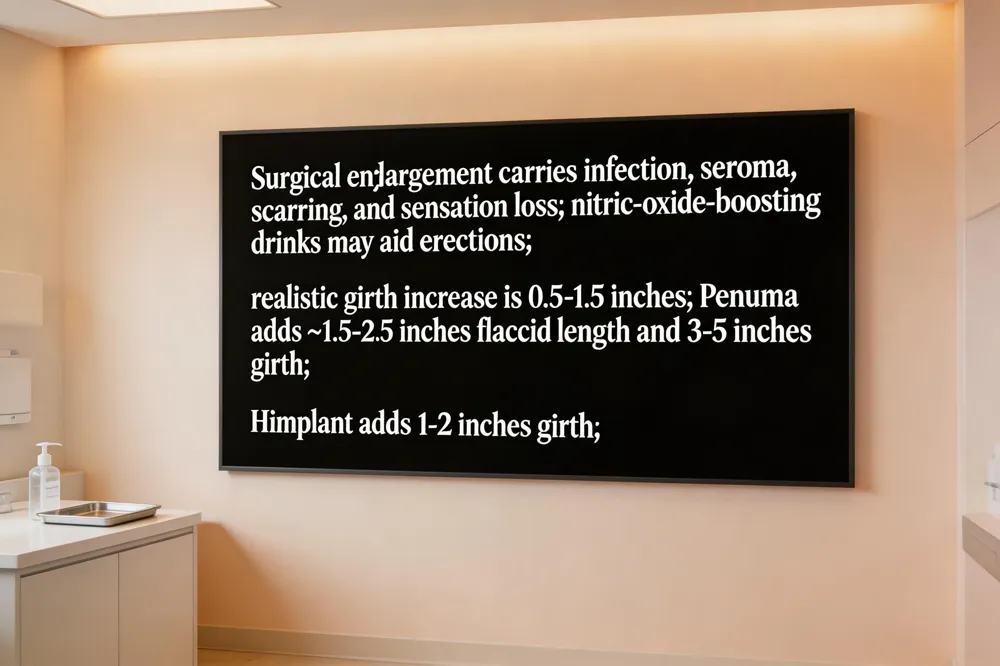
What are the cons of a penis enlargement surgery? Surgical enlargement carries infection risk, seroma, scarring, loss of sensation, erectile rigidity, possible penile instability, uneven aesthetics, and a long, uncomfortable recovery. Costs are high and outcomes can fall short of expectations.
What can I drink for a full erection? Choose nitric‑oxide‑boosting beverages: beetroot juice (dietary nitrates), pomegranate juice (antioxidants), watermelon juice (citrulline), and green tea (catechins). Stay well‑hydrated with water to maintain blood volume.
How much girth increase is realistic? Most procedures add 0.5–1.5 inches (1.2–4 cm) to erect girth. Hyaluronic‑acid fillers usually yield 0.5–1 inch; surgical grafts or implants may reach the upper end, rarely exceeding 2 inches.
Does men's clinic help with STI? Yes. The Men’s Clinic provides comprehensive STI screening and treatment within a broader men’s‑health program that also addresses sexual dysfunction and overall wellness.
How many inches does Himplant add? Himplant typically adds 1–2 inches of girth and a modest ½‑inch boost in flaccid length, preserving natural sensation and erectile function.
How many inches does Penuma add? Penuma adds roughly 1.5–2.5 inches to flaccid length and increases girth from ~3.3 in to ~5.3 in (≈56 % gain), with results maintained long‑term.
Is baking soda good for erectile dysfunction? Limited evidence supports baking soda for ED. Small daily doses may affect blood pH, but excessive use can disrupt electrolytes. Proven nitric‑oxide‑boosting foods are preferred, and any supplement should be discussed with a clinician.
Putting the Numbers Into Practice
Data‑driven patient counseling begins with objective baseline measurements—flaccid and erect length, girth, and validated questionnaires (IIEF, K10, RSES, BIQLI). For example, a prospective HA filler study showed a mean flaccid girth increase of 3.29 cm (Cohen’s d = 2.13) with no complications, and 47 % of participants reported higher self‑confidence. By presenting these statistics clinicians can set realistic expectations, explain the likely magnitude of change, and discuss the low complication profile of HA fillers versus surgical options.
Continuous quality improvement relies on systematic collection of patient‑reported outcome measures (PROMs) at 1, 3, 6, and 12 months—using tools such as the PSQ‑18, EDITS, or NPS. Linking outcomes (e.g., reduction in BDD criteria, self‑discrepancy scores) to process variables (wait times, counseling length) mirrors the safety‑net urology findings where wait‑time reductions boosted satisfaction. Regular audit of complication rates, aesthetic concerns (21 % in the HA study), and psychological distress (K10 unchanged) informs protocol tweaks and staff training.
Personalized treatment planning integrates these data points with individual psychosocial profiles. Men with pre‑procedure BDD (11 % in the HA cohort) benefit from counseling that often resolves BDD criteria at six months. Patients expressing specific goals—enhanced confidence, sexual pleasure (42 % reported increase)—can be matched to minimally invasive HA augmentation, which offers a statistically significant girth gain without the higher risk profile of surgical implants. By aligning measurable outcomes with personal motivations, clinicians deliver tailored, evidence‑based care that maximizes satisfaction and quality of life.