

Understanding Penile Girth Fillers
Penile girth fillers are injectable biocompatible substances placed subcutaneously in the shaft to temporarily increase circumference without surgery. The most widely used material is hyaluronic acid (HA), a naturally occurring polysaccharide that retains moisture and adds volume; it is FDA‑approved for facial aesthetics and employed off‑label for penile enhancement. Other fillers reported in the literature include calcium hydroxylapatite (CaHA), which stimulates collagen production and can last up to 12‑18 months, and poly‑L‑lactic acid (PLLA), a biostimulator that gradually builds girth and may persist for about two years.
A typical workflow begins with a confidential consultation to assess medical history, realistic expectations, and candidacy. After confirming that the patient is a healthy adult male with normal erectile function and no active infection, active bleeding disorder, or severe allergy to filler components, the procedure is performed in an outpatient setting under local anesthesia (topical numbing plus lidocaine). The injector—usually a board‑certified urologist or plastic surgeon with specialized training—uses a blunt cannula or fine‑gauge needle to deposit the filler in the plane between Buck’s fascia and the dartos fascia, achieving even distribution while protecting nerves and vessels. Sessions often last 30–60 minutes, using 10–20 mL of HA (or equivalent volumes of CaHA/PLLA) to gain roughly 1–3 cm of girth.
Ideal candidates are men seeking a temporary, non‑permanent increase in girth, have realistic expectations, and are willing to follow post‑procedure care, which includes abstaining from sexual activity for 1–2 weeks and monitoring for infection. Safety protocols emphasize sterile technique, aseptic preparation, and the ability to reverse HA with hyaluronidase if needed. Although no filler is FDA‑cleared specifically for penile use, the products themselves are approved for other cosmetic indications, and reputable clinics adhere to strict regulatory and ethical standards to minimize risks.
Effectiveness, Duration, and Safety of Hyaluronic‑Acid Fillers

How long do penile girth injection results last?
HA filler effects last 12–18 months before gradual absorption.
Calcium‑hydroxyapatite may last up to a year.
Polylactic acid (PLA) fillers work by stimulating collagen production; results may last up to about two years.
Are hyaluronic‑acid girth fillers safe?
Hyaluronic acid is a naturally occurring polysaccharide that retains moisture and adds volume.
Minimal discomfort during injection; soreness resolves within a few days.
Common side effects: mild swelling, bruising, temporary lumps; rare: infection, uneven filler.
Hyaluronidase can reverse HA fillers quickly if needed.
What girth measurement is considered impressive?
A circumference of 5‑7.5 inches (12.7‑19.1 cm) is often viewed as aesthetically pleasing; many patients and partners describe >6 inches (15 cm) as “impressive.”
How much erect girth does a filler add per session?
Each staged injection of 2–6 cc of filler usually increases penile girth by approximately 0.25‑0.5 inches.
How much bigger can penile filler make you?
On average, HA filler provides a 15‑20 % increase in overall dimensions—roughly ½‑1 inch of added length and 0.5‑1 inch of extra girth, depending on baseline size and injected volume.
What are common side effects of penile fillers?
Common side effects: mild swelling, bruising, temporary lumps; rare: infection, uneven filler.
Cost Landscape for Penile Enhancement
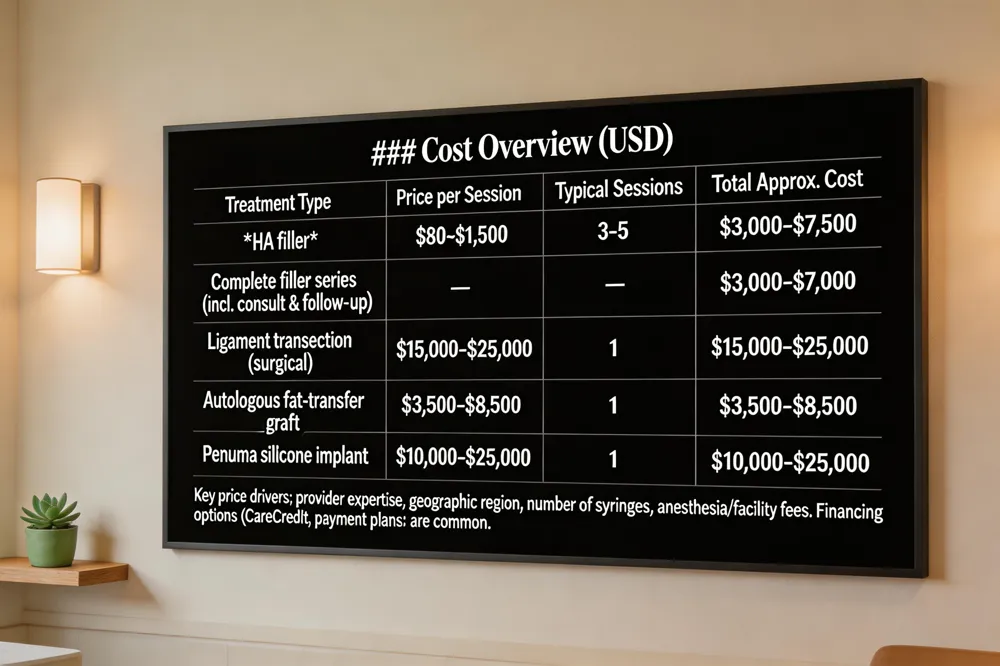 Penile girth enhancement can be achieved with non‑surgical injectable fillers or with surgical procedures, and the price varies widely. Non‑surgical filler treatments typically range from $800 to $1,500 per hyaluronic‑acid (HA) injection; most men undergo three to five sessions, bringing the total investment to $3,000‑$7,500. A complete filler series—including initial consultation, the HA product, and follow‑up care—usually falls between $3,000 and $7,000, with higher‑priced clinics in major metros or those led by double‑board‑certified surgeons at the upper end. Surgical enlargement costs are considerably higher: ligament transection $15,000‑$25,000, autologous fat‑transfer grafts $3,500‑$8,500, and FDA‑cleared Penuma silicone implants $10,000‑$25,000. Factors influencing price include provider expertise, geographic region, number of syringes used, and ancillary fees for anesthesia or facility overhead. Many clinics offer financing options such as CareCredit, payment plans, or package discounts to make treatment more accessible.
Penile Girth Fillers vs. Other Augmentation Options
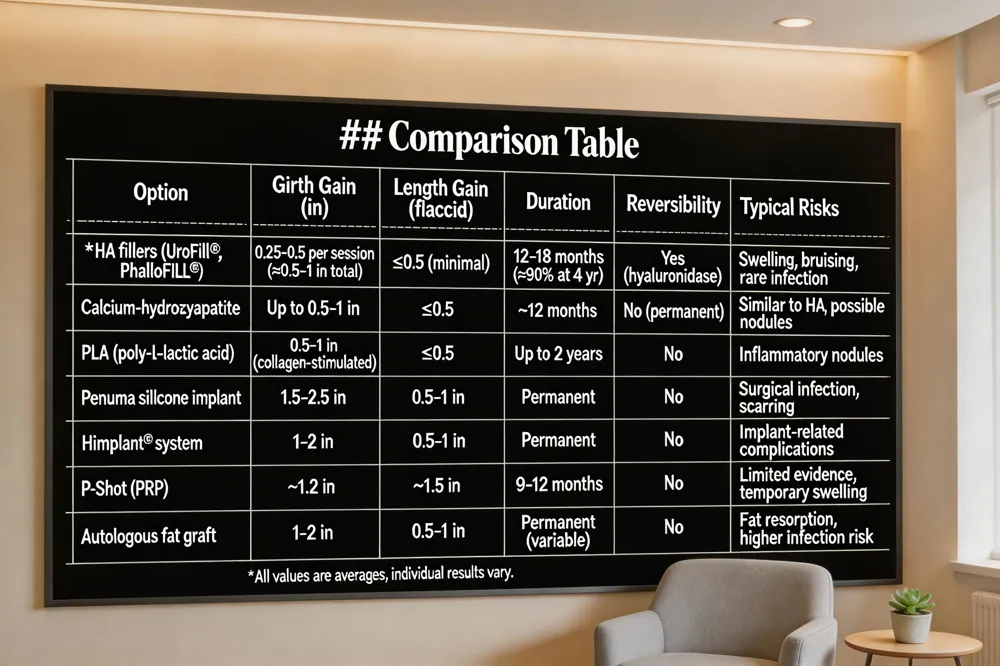 Penile Girth Fillers vs. Other Augmentation Options
Penuma silicone implants add roughly 1.5 to 2.5 inches of flaccid length, with a comparable increase in girth; most men achieve gains near the lower end of that range, while larger XXL models can approach the upper limit. The Himplant® system is designed primarily for girth, providing 1 to 2 inches of circumference increase and a modest 0.5 to 1 inch of flaccid length gain, without significant change in erect length. The P‑Shot (platelet‑rich plasma) protocol, typically six injections, reports an average of ~1.5 inches (38 mm) of flaccid length and ~1.2 inches (30 mm) of girth, lasting 9‑12 months. UroFill® and PhalloFILL® use hyaluronic‑acid fillers; they deliver immediate girth gains of 0.25‑0.5 inch per session, retain roughly 90 % of volume after four years, and do not increase erect length. Surgical grafts and autologous fat remain the gold standard for permanent augmentation, but carry higher infection and scarring risk.
Choosing the Right Candidate and Ensuring Safety
 A thorough health screening is the first step in selecting men for nonsurgical penile girth enhancement. Candidates should be healthy adults with normal erectile function, no active infections, bleeding disorders, or severe dermatologic conditions, and must have realistic expectations about temporary, non‑permanent results. Because the procedure involves injecting filler into delicate genital tissue, it should be performed only by board‑certified urologists or plastic surgeons who have completed specialized training in penile anatomy and filler techniques. Using a blunt cannula rather than a sharp needle minimizes the risk of vascular injury and bruising, while strict aseptic preparation—antiseptic skin prep, sterile gloves, and a controlled environment—reduces infection risk. Post‑procedure care includes a brief period of abstinence, gentle compression, and monitoring for swelling, bruising, or nodules. Importantly, hyaluronic‑acid fillers are fully reversible with hyaluronidase, providing an added safety net should the patient be dissatisfied or develop complications.
Procedure Workflow and Recovery Timeline
 A typical appointment for nonsurgical penile girth enhancement lasts 30–60 minutes and is performed in an outpatient setting under local anesthesia. After a topical numbing cream, a lidocaine‑containing solution (often mixed with the filler) is injected to ensure patient comfort. The injector uses a layered, sub‑Buck’s fascia technique—often with a blunt micro‑cannula—to deposit 10–20 mL of hyaluronic‑acid gel in concentric planes, creating a natural‑looking increase in circumference. Results are visible immediately, though mild swelling may peak within the first 24–48 hours and resolve over the next few days. Patients are advised to avoid sexual activity and vigorous exercise for 1–2 weeks to allow the filler to settle. Follow‑up visits are typically scheduled at 1–2 weeks, 3 months, and 12 months to assess healing, address any irregularities, and discuss maintenance treatments.
Psychological Considerations and Counseling
 Size‑related anxiety, known as small‑penis anxiety (SPA) or penile dysmorphophobia disorder (PDD), can erode self‑esteem and affect intimacy. Studies consistently show that addressing these concerns with professional counseling before any procedure helps patients set realistic expectations and reduces the risk of post‑procedure regret. A structured counseling session can clarify that non‑surgical fillers, such as hyaluronic‑acid injections, provide temporary, reversible girth gains without compromising erectile function, which often eases anxiety about permanence. Clinicians often recommend exploring reversible, minimally invasive options first because the transient nature of filler results allows patients to evaluate satisfaction before committing to permanent surgery. When counseling demonstrates realistic motivation and realistic goals, the subsequent enhancement—whether hyaluronic‑acid, UroFill®, or other FDA‑approved dermal fillers—can boost confidence and improve sexual self‑image, supporting overall mental well‑being.
Advanced Techniques, Research, and Future Directions
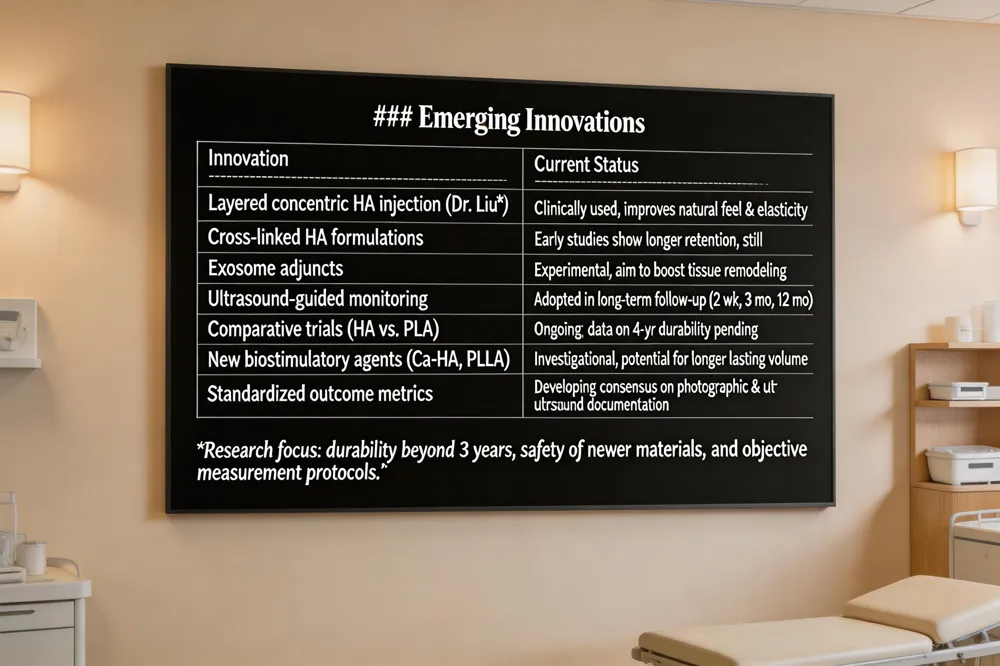 Dr. Victor Liu’s patented layered injection technique deposits hyaluronic acid (HA) in multiple concentric planes beneath Buck’s fascia, achieving natural‑looking girth while preserving elasticity. Recent work adds cross‑linked HA formulations and experimental exosome adjuncts to prolong volume and stimulate healthy tissue remodeling. Clinics now follow structured long‑term monitoring: follow‑up visits at 2 weeks, 3 months, and 12 months with ultrasound or photographic documentation to detect irregularities, infection, or filler migration. Ongoing clinical trials are evaluating HA versus polylactic‑acid fillers, while data gaps remain on 4‑year durability and comparative safety of newer biostimulatory agents. Emerging filler materials such as calcium‑hydroxyapatite and poly‑L‑lactic acid are being studied for longer retention, but HA remains the gold standard due to reversibility with hyaluronidase.
Q: Can you actually increase penile length?
A: Lengthening is limited to surgical ligament release or implants; non‑surgical methods lack robust evidence and may cause harm.
Q: Is it normal to gain 5 inches when erect?
A: No—normal erect length averages 5‑7 inches; a 5‑inch gain would require invasive augmentation and carries significant risk.
Q: What makes a man’s penis bigger?
A: Genetics and hormonal development set baseline size; after puberty only medical interventions—fillers, grafts, ligament release, or implants—can add girth or modest length.
Q: What is the best surgical option for male enlargement?
A: The Penuma™ silicone implant, placed by a double‑board‑certified surgeon such as Dr. Liu, offers permanent, predictable girth and length enhancement with a low complication profile.
Final Thoughts
Key takeaways from the FAQs: Nonsurgical penile girth enhancement using hyaluronic‑acid fillers provides an immediate, temporary increase of 1–3 cm (0.4–1.2 in) that typically lasts 12–18 months and can be safely reversed with hyaluronidase. The procedure is minimally invasive, performed under local anesthesia, and carries a low complication rate when performed by board‑certified urologists or plastic surgeons using blunt‑cannula techniques.
When to seek a specialist consultation: Men with realistic expectations, good overall health, and a desire for a non‑permanent girth boost should schedule a confidential evaluation. Ideal candidates are adults without active infections, bleeding disorders, or severe anxiety about size. A thorough medical history and discussion of goals will determine the appropriate filler type, volume, and staging.
Emphasizing safety, realistic expectations, and personalized care: Choose an experienced provider who follows strict aseptic protocols, offers detailed post‑procedure instructions, and can perform hyaluronidase reversal if needed. Understanding the temporary nature of results, the required sexual‑abstinence period (1–2 weeks), and the need for periodic maintenance ensures patients achieve natural‑looking outcomes while maintaining confidence and sexual health.