

Why Legal Clarity Matters
The surge in male aesthetic demand—evidenced by an 18‑year rise in Google‑tracked interest and over 820,000 nonsurgical procedures in 2020—creates new business opportunities but also amplifies regulatory exposure. Clinicians must navigate FDA device clearances, state board licensure, and FTC advertising rules; failure to use only FDA‑cleared implants or to label off‑label filler use correctly can trigger misbranding actions, warning letters, or civil penalties. Equally critical is a thorough informed‑consent process that documents risks, benefits, alternatives, and the experimental nature of many genital enhancements. Proper consent not only safeguards patient autonomy and privacy under HIPAA but also forms a legal shield against malpractice claims arising from inadequate disclosure or unmet expectations.
Regulatory Framework for Male Aesthetic Devices

In the United States, any device used to alter male genital appearance must first meet the Food and Drug Administration’s (FDA) definition of a medical device under Section 201(h) of the FD&C Act. Devices that claim to increase penile length, girth, or treat curvature are classified as Class II or Class III devices and therefore require a 510(k) pre‑market notification or a full Premarket Approval (PMA) before they can be marketed. The 510(k) pathway demonstrates that the new device is substantially equivalent to a legally marketed predicate, while the PMA demands extensive clinical data to prove safety and effectiveness.
State medical boards enforce that any clinician performing aesthetic genital procedures hold a valid, unrestricted medical license in the state where the service is rendered and, for most jurisdictions, be board‑certified in a relevant specialty such as urology, plastic surgery, or dermatology. This licensure ensures that physicians possess the training and competence to meet the standard of care for both surgical and non‑surgical interventions.
The Federal Trade Commission (FTC) regulates advertising of aesthetic services, mandating that all claims about penile enhancement be truthful, non‑misleading, and substantiated by reliable scientific evidence. Advertisers must avoid absolute guarantees of size increase, must disclose off‑label status when applicable, and must ensure that before‑and‑after images are unaltered and representative of typical outcomes. Non‑compliance can trigger FTC enforcement actions, including fines and mandatory corrective advertising.
Finding Certified Surgeons and Clinics

When seeking male genital enhancement, the most important safeguard is a surgeon’s board certification. In the United States, physicians must hold a valid state medical license and be board‑certified in a relevant specialty—plastic surgery, urology, or dermatology. Double‑board certification (e.g., ABPS and ABU) signals extensive training in both aesthetic and functional aspects of genital surgery, providing an added layer of expertise.
How to verify surgeon credentials
Start by checking the physician’s license status on the state medical board website and confirm board certification through the American Board of Plastic Surgery or the American Board of Urology. Request the surgeon’s CV, peer‑reviewed publications, and before‑and‑after photo documentation. Clinics that are accredited by the Joint Commission or AAALIF and that list FDA‑cleared devices (such as the Penuma silicone implant) demonstrate compliance with safety standards.
Geographic considerations for the Bay Area
The Bay Area hosts several double‑board‑certified surgeons who specialize in male genital aesthetics. Proximity reduces travel burden for pre‑operative imaging, in‑person consultations, and post‑procedure follow‑up, which are essential for optimal outcomes.
Penis enlargement surgery near me
If you’re looking for penile‑enlargement surgery close to you, start by searching for board‑certified plastic surgeons or urologists who specialize in male genital aesthetics—particularly those who are double‑board certified like Dr. Victor Liu in the Bay Area. Dr. Liu offers FDA‑cleared Penuma silicone‑sleeve implants and ligament‑release procedures that have been shown in a large single‑surgeon study to increase flaccid girth by ≈ 57 % and provide high long‑term satisfaction, with most complications being minor (seroma ≈ 5 %, scar ≈ 4.5 %, infection ≈ 3 %). Verify each surgeon’s credentials, request before‑and‑after photographs, and schedule a private consultation to discuss your goals, expected outcomes, and potential risks. Many clinics also provide minimally invasive options such as injectable fillers or fat grafting for men who prefer non‑surgical enhancement. Choosing a surgeon with proven safety data and a personalized approach will help you achieve natural‑looking results while minimizing downtime.
Penis enlargement clinic
Our Bay Area penis‑enlargement clinic, led by double‑board‑certified plastic surgeon Dr. Victor Liu, offers a full spectrum of personalized male‑enhancement solutions—from minimally invasive dermal‑filler and Botox “bio‑hack” procedures to state‑of‑the‑art surgical grafts and penile‑implant options. During a confidential consultation we use advanced imaging to map your anatomy and discuss realistic goals, ensuring every treatment is tailored to your unique physiology. All procedures prioritize safety, using FDA‑approved materials such as hyaluronic‑acid fillers and delivering natural‑looking results with minimal downtime. We also provide comprehensive education and post‑procedure support to help you achieve lasting confidence and optimal sexual health.
Surgical Options, Penuma Implant, and Cost
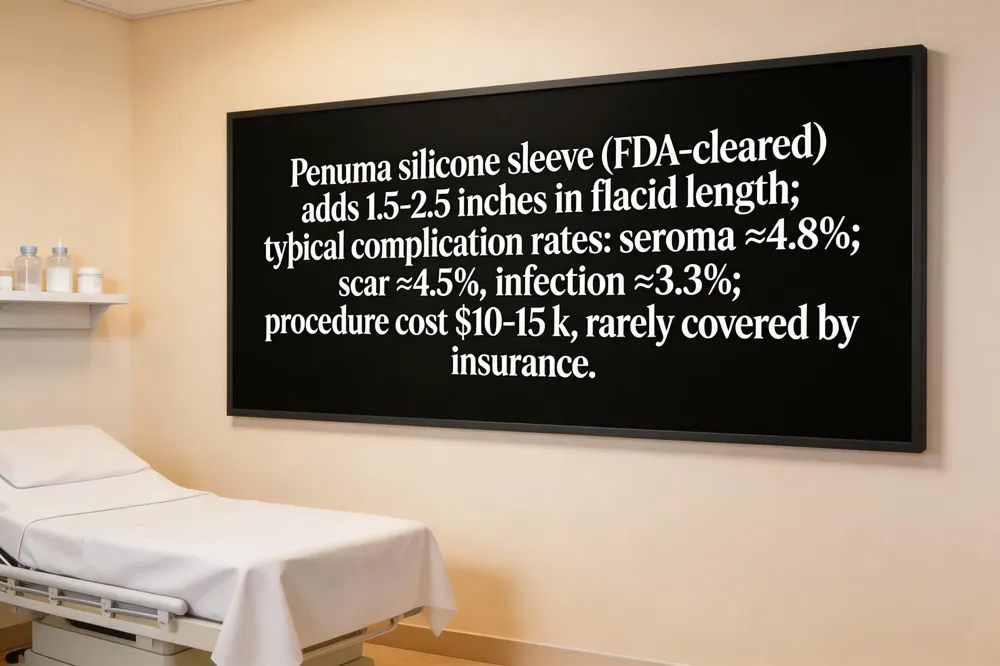
Penuma’s FDA‑cleared silicone sleeve is inserted subcutaneously through a concealed scrotal incision, forming a soft, anatomically shaped graft that augments both length and girth. In the largest series, seroma occurs in about 4.8 % of cases, scar formation in 4.5 % and infection in 3.3 %; rarer events include migration, sensation loss, erectile dysfunction, and cosmetic dissatisfaction. The device typically adds 1.5‑2.5 inches to flaccid length and a comparable girth increase, though individual outcomes vary with baseline anatomy and healing. Permanent enlargement procedures such as Penuma implantation or ligamentolysis generally cost $10,000‑$15,000 USD, covering surgeon fees, anesthesia, facility charges, and post‑operative care. Insurance rarely covers cosmetic surgery, so patients pay out‑of‑pocket or use clinic‑offered financing. Selecting a board‑certified, double‑board‑certified surgeon—who follows FDA regulations, obtains detailed informed consent, and adheres to strict sterile technique—maximizes safety and satisfaction.
Non‑Surgical Devices, Vacuum Pumps, and Home Methods

Vacuum erection devices (VEDs) work by creating a sealed chamber around the penis and using a hand‑ or battery‑powered pump to draw air out, producing negative pressure that draws blood into the corpora cavernosa. The resulting engorgement can make the penis appear larger during and immediately after a session, but the effect is transient; studies in peer‑approved cohort V reviewed erectile dysfunction patients show no statistically significant increase in flaccid or erect length after regular use, and any modest gain is attributable to fluid accumulation that resolves once suction stops.
Because VEDs do not stimulate permanent tissue remodeling, they cannot deliver lasting size enhancement. For men seeking durable results, surgical options such as grafting or suspensory ligament release—performed by a board‑certified plastic surgeon or urologist—remain the only evidence‑based interventions.
Home‑based stretching methods, jelqing, and topical “enhancement” creams lack robust clinical data and carry risks of micro‑tears, fibrosis, and vascular injury. Unregulated devices may be misbranded, and off‑label use of injectable fillers without FDA clearance can lead to serious complications, including infection and loss of sensation.
Can a vacuum pump permanently increase size? No. VEDs provide temporary engorgement; they do not produce permanent length or girth gains.
Real way to increase your size at home? Current medical literature does not support home stretching, jelqing, or creams as safe or effective. Validated treatments are prescription‑based therapies or surgery performed by a qualified specialist.
Injectable Fillers, Off‑Label Use, and Supplements

The FDA has not cleared any injectable filler or dietary supplement for purely cosmetic penis enlargement; only devices cleared for specific medical indications (e.g., erectile dysfunction) may be marketed, and off‑label filler use must be disclosed and documented. Unapproved injectable materials—such as methacrylate, non‑FDA‑cleared silicone, or experimental fillers—pose serious risks, including infection, fibrosis, granuloma formation, loss of sensation, and erectile dysfunction. Advertising that guarantees size gains without scientific substantiation violates FTC advertising rules for penis enlargement products and can trigger enforcement actions, including fines and corrective advertising.
Male enhancement pills near me – Local pharmacies and online retailers stock “male‑enhancement” supplements, but none have FDA approval for increasing penis size; many contain hidden prescription‑drug ingredients that can cause severe adverse events. Consult a board‑certified specialist, such as Dr. Victor Liu, for safe, evidence‑based options.
Best male enhancement pills sold in stores – No over‑the‑counter pill enlarges the penis. FDA‑approved PDE‑5 inhibitors (e.g., sildenafil) improve erections but do not increase length or girth. Professional evaluation is essential.
Penis enlargement medication – No FDA‑approved drug exists for permanent size increase. Unapproved pills may contain unsafe doses of sildenafil or other substances. Discuss any medication‑based interest with a qualified urologist or plastic surgeon.
Penis enlargement pills that work – None are FDA‑approved or proven to enlarge permanently. Seek counsel from a board‑certified specialist for safe, personalized care.
Medication, PDE‑5 Inhibitors, and Their Limits

Sildenafil and tadalafil are FDA‑approved oral phosphodiesterase‑5 (PDE‑5) inhibitors for the treatment of erectile dysfunction (ED) and, for tadalafil, benign prostatic hyperplasia. Their mechanism enhances nitric‑oxide‑mediated vasodilation, improving erectile rigidity, but they do not increase penile length or girth. The distinction between a performance aid and a size‑enhancement claim is critical: clinical trials and FDA labeling support only the former, while marketing that promises permanent size gain violates FTC truth‑in‑advertising rules and may constitute misbranding under the FD&C Act. Common adverse effects include headache, flushing, dyspepsia, nasal congestion, and visual disturbances; rare but serious events are hypotension, priapism, and cardiovascular complications in patients with significant heart disease. Contraindications encompass concurrent nitrate therapy, severe uncontrolled hypertension, recent stroke or myocardial infarction, and known hypersensitivity to the drug. Physicians must obtain thorough informed consent, disclose the lack of evidence for size augmentation, and ensure patients understand the therapeutic scope and safety profile of these agents.
Legal Risks, Malpractice, and Informed Consent

Penile augmentation carries distinct legal vulnerabilities. The most frequent malpractice claims involve inadequate informed‑consent documentation, postoperative infection or seroma, implant migration or extrusion, loss of sensation, erectile dysfunction, and unsatisfactory cosmetic results. Courts often treat a failure to disclose the experimental nature of off‑label filler use or the limited durability of silicone implants as a breach of the standard of care. In California and several other states, statutory caps on pain‑and‑suffering damages (e.g., $250,000 under MIRCA) do not apply to medical‑battery claims, allowing juries to award multi‑million dollar verdicts when a procedure deviates materially from the consented plan. To mitigate risk, clinicians should maintain meticulous records: a signed, detailed consent form that enumerates risks, benefits, alternatives, and the off‑label status of any device; pre‑operative photographs and measurements; device lot numbers and clearance documentation; and a postoperative follow‑up log that captures any complications and remedial actions.
Penis enlargement surgery side effects – In the largest Penuma series, seroma occurred in ~4.8 % of patients, scar formation in ~4.5 %, and infection in ~3.3 %. Less common but significant issues include implant migration or extrusion, loss of penile sensation, erectile dysfunction, and cosmetic dissatisfaction. These events are largely preventable through strict sterile technique, prophylactic antibiotics, careful patient selection, and thorough pre‑operative counseling. When performed by an experienced, double‑board‑certified surgeon, overall serious complication rates remain low and long‑term patient satisfaction is high.
Patient Evaluation, Psychological Screening, and Ethical Care

A thorough medical review is the foundation of any male aesthetic plan. Clinicians first screen for body‑dysmorphic disorder and other psychological conditions that may drive unrealistic expectations; patients identified with significant distress are referred for counseling before any procedure. When off‑label agents (e.g., hyaluronic‑acid fillers for penile girth) are considered, the physician must disclose the experimental nature, lack of FDA approval for that indication, and obtain a detailed informed‑consent signed. Counseling sessions focus on realistic outcomes, the limited durability of non‑surgical methods, and the risks of complications.
Is it possible to enlarge penis size permanently without surgery? Current evidence shows no reliable, medically‑approved non‑surgical method for permanent length or girth gain. Over‑the‑counter pills, creams, and “jelqing” may cause temporary swelling but lack lasting tissue growth and can cause injury. Penile traction devices have produced modest 1–3 cm gains in small studies after months of daily use, but results are not guaranteed to be permanent. For lasting, predictable enhancement, surgical or minimally invasive FDA‑cleared options (e.g., hyaluronic‑acid fillers, Penuma® implant) are the only evidence‑based choices; most men benefit more from counseling and setting realistic expectations.
Penis enlargement treatment Treatment options fall into three categories: 1) Surgical – Penuma® silicone implant, suspensory ligament release, grafting; 2) Minimally invasive – vacuum erection devices, topical agents, platelet‑rich plasma; 3) Lifestyle & counseling – weight loss, smoking cessation, therapy for body‑image concerns. A personalized plan is devised after comprehensive medical and psychological evaluation.
Key Takeaways for Safe and Legal Male Aesthetic Care
Select a surgeon who holds a valid state license and board certification—ideally double‑board (plastic surgery and urology or dermatology). Use only FDA‑cleared devices and treatments supported by peer‑reviewed evidence. Obtain detailed, written informed consent that explains risks, benefits, alternatives, and realistic outcomes before any procedure for patient safety and success.