

Overview of Legal Foundations
In the United States, all devices used for male cosmetic enhancement—penetrates implants, injectable fillers, and vacuum‑based systems—must obtain FDA clearance or approval before clinical use. Physicians must hold a valid state medical license and, in most states, be board‑certified in plastic surgery, urology, or a related specialty to perform genital procedures. Informed‑consent statutes require a written, plain‑language disclosure of risks, benefits, alternatives, and any off‑label status, with the patient’s signature documented in the medical record. HIPAA obligates clinics to secure all health‑information records and obtain patient authorization before any sharing. The No Surprises Act further protects patients by mandating a Good‑Faith Estimate for out‑of‑pocket or uninsured cases, capping cost‑sharing at in‑network rates and providing a dispute‑resolution pathway for billing errors.
Regulatory Framework for Devices and Procedures

The Federal Trade Commission enforces truth‑in‑advertising standards; any claim of “natural results,” “guaranteed size increase,” or “minimal invasiveness” must be supported by peer‑reviewed evidence or FDA clearance, or the clinic may face civil penalties up to $10,000 per violation.
Telemedicine consultations are permissible only when the treating physician holds a valid license in the patient’s state and complies with that state’s telehealth statutes; an in‑person examination is still required before any invasive procedure is performed.
Male enhancement meaning – Refers to medically supervised interventions—surgical (implants, ligament release) or non‑surgical (vacuum pumps, PRP, testosterone therapy)—aimed at improving sexual function or penile size, always prioritizing safety and realistic outcomes.
Cosmetic vs aesthetic surgery – Cosmetic surgery is elective and focuses solely on appearance; aesthetic surgery combines visual improvement with functional restoration (e.g., correcting congenital abnormalities while enhancing contour).
Is it possible to enlarge penis size medically? – Yes, modest gains in girth (1‑2 cm) or flaccid length are achievable via FDA‑cleared implants or off‑label fillers, but results are limited and carry risks such as infection or sensation loss.
Board‑certified ENT and plastic surgeon – Dual certification demonstrates mastery of both head‑and‑neck anatomy and reconstructive aesthetics, ensuring comprehensive, safe care for complex male genital procedures.
Surgeon Qualifications and Certification

State licensing and board certification are the foundation of safe male‑enhancement care. Every physician who performs genital surgery must hold a current, valid medical license in the state where the procedure is performed, and most states—California, New York, Texas, etc.—require board certification in a relevant specialty such as plastic surgery or urology.
American Board of Plastic Surgery (ABPS) written exam – The ABPS administers a Computer‑Based Test at Prometric centers across the U.S., Canada, and Puerto Rico. The six‑hour exam consists of three blocks of 100 multiple‑choice questions (250 scored items plus 50 unscored items) with an optional 60‑minute break. It evaluates anatomy, surgical technique, patient safety, ethics, and aesthetic principles. Candidates must apply by early October, register by February, and results are released in July.
Dual specialty credentials – Many surgeons hold dual certification (e.g., plastic surgery and otolaryngology), demonstrating mastery of both functional anatomy and aesthetic reconstruction. Dual‑certified surgeons can address complex functional and cosmetic goals in a single practice, reducing referrals and streamlining care.
California license verification – To confirm a surgeon’s licensure, use the Medical Board of California’s License Verification portal (https://www.mbc.ca.gov/License-Verification/default.aspx). Enter the physician’s name or license number to view status, expiration, disciplinary history, and practice address. For assistance, call (916) 263‑2382, Monday‑Friday 8 a.m.–5 p.m. PT.
These safeguards—state licensure, ABPS certification, dual specialty training, and transparent verification—ensure that patients receive expert, legally compliant, and ethically sound male cosmetic procedures.
Procedural Options, Outcomes, and Costs
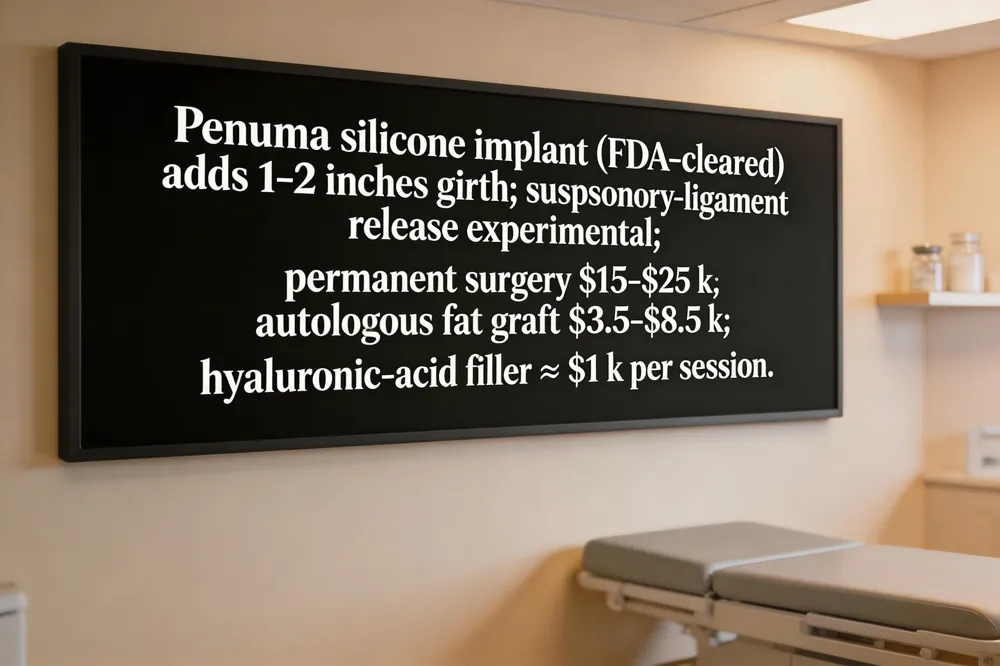
In the United States, male genital enhancement must be performed by a physician holding a valid state medical license and, for most procedures, board certification in plastic surgery or urology. The Food and Drug Administration (FDA) regulates all devices used—only one penile implant, the Penuma silicone device, has received FDA clearance for soft‑tissue augmentation; other injectables are used off‑label and require explicit patient disclosure.
Best male enlargement surgery – The most reliable permanent option is the FDA‑cleared Penuma implant, which adds 1–2 inches of girth and a modest increase in flaccid length. For men seeking additional erect length, a suspensory‑ligament release may provide up to an inch of visible length but is considered experimental by the American Urological Association and must be performed under strict informed‑consent protocols.
Permanent male enlargement surgery cost – Out‑of‑pocket expenses range from $15,000 to $25,000. Penuma implantation averages around $20,000, while ligament‑transection procedures fall in a similar bracket. Less invasive girth‑augmentation methods, such as autologous fat grafting, cost $3,500–$8,500; dermal‑filler injections start near $1,000 per session but may require repeat treatments.
How many inches does Himplant add? – Clinical data report a consistent 1–2 inches increase in girth, with only a few millimeters of flaccid length gain. The implant sits beneath the skin, preserving sensation and natural erectile function.
Penis enlargement surgery near me – Locate a board‑certified plastic surgeon or urologist in your state—verify certification through the American Board of Medical Specialties and ensure the clinic complies with HIPAA, the No Surprises Act, and state malpractice insurance requirements. Dr. Victor Liu, a double‑board‑certified surgeon, exemplifies this standard of care, offering confidential consultations and financing options.
Patient Rights, Safety Protocols, and Non‑Surgical Options

Informed consent is a legal and ethical cornerstone for every male cosmetic intervention. Before any procedure, patients receive a written summary of risks, benefits, alternatives, and the experimental nature of off‑label devices, and they must sign the document.
Who may perform aesthetic procedures? Only physicians holding a valid state medical license and board‑certified in a relevant specialty—plastic surgery, urology, dermatology, or an accredited aesthetic fellowship—are permitted to inject fillers, administer neuromodulators, or perform genital surgery. At our clinic, Dr. Victor Liu, a double‑board‑certified plastic surgeon, personally oversees all interventions; non‑licensed personnel may not conduct these procedures.
Natural health‑based enhancement strategies focus on cardiovascular fitness, weight control, smoking cessation, and balanced nutrition, which improve penile blood flow. Evidence‑based supplements such as L‑arginine or Panax ginseng may modestly aid erectile function, but they must be discussed with a qualified physician to avoid drug interactions.
Potential side effects and complications include postoperative infection, scarring, sensory loss, erectile dysfunction, chronic pain, curvature, or unsatisfactory aesthetic outcomes. Non‑surgical fillers can cause lumpiness or asymmetry, while surgical options carry higher revision rates.
Penis enlargement treatment ranges from hyaluronic‑acid filler injections (adding ¼–½ inch girth per session) to surgical grafts or implants. Pills, lotions, and unproven “jelqing” are discouraged due to lack of scientific support and tissue‑damage risk.
Elective cosmetic surgery is chosen for appearance rather than medical necessity. A comprehensive pre‑operative assessment—reviewing anatomy, functional concerns, and health optimization—ensures safe, natural results.
Natural male enhancement emphasizes aerobic exercise, a heart‑healthy diet, and management of comorbidities; supplements should be used only under medical guidance.
Penis enlargement surgery side effects can include infection, scarring, loss of sensation, erectile dysfunction, pain, curvature, and the need for revision surgery. Discussing these risks during the consent process is essential for informed decision‑making.
Clinic Selection, Advertising, and Legal Recourse

When seeking male genital enhancement, start by confirming that the clinic is led by a physician who holds a valid state medical license and board certification in plastic surgery, urology, or a related specialty. Double‑board‑certified surgeons such as Dr. Victor Liu exemplify the highest credentialing standards. Verify that the practice uses FDA‑cleared devices—e.g., hyaluronic‑acid fillers for girth augmentation—and that any off‑label use is disclosed in writing during the informed‑consent process.
Advertising must satisfy Federal Trade Commission (FTC) truth‑in‑advertising rules: claims of “natural results,” “guaranteed size increase,” or “minimal invasiveness” must be backed by peer‑reviewed data or FDA clearance. Clinics that overstate efficacy risk civil penalties and may be subject to consumer‑protection actions.
Patients should also be wary of over‑the‑counter sexual‑enhancement supplements. The FDA has repeatedly warned that products like Big Penis Male Sexual Stimulant and CONTROL All Natural Sexual Enhancement contain hidden prescription drugs (e.g., sildenafil, tadalafil), which are illegal without a prescription and can cause dangerous drug interactions.
Statistically, male cosmetic surgery accounts for roughly 7‑10 % of all U.S. procedures, with upper‑eyelid surgery (blepharoplasty) being the most common. Penile enlargement remains a niche, experimental service—only the Penuma silicone implant has FDA clearance, and most other techniques are considered off‑label or investigational.
For those considering a “daddy do‑over” (the male analog of a mommy makeover), a personalized plan may combine liposuction, gynecomastia correction, abdominal tuck, and facial rejuvenation. All procedures require thorough pre‑operative counseling, documented informed consent, and compliance with HIPAA privacy standards.
Key Takeaways for Safe and Informed Male Enhancement
Patients seeking male enhancement must first verify that every device or drug used has FDA clearance or approval, and that any off‑label application is fully disclosed. State medical boards require a valid physician license and often board certification in plastic surgery, urology, or a related field; clinicians should provide proof of such credentials. Informed consent is legally mandatory—written explanations of risks, benefits, alternatives, and experimental status must be signed before any procedure. Realistic expectations rely on evidence‑based options; only FDA‑cleared implants, approved fillers, and proven traction or vacuum therapies have documented safety and modest efficacy. Choosing a clinic that follows ASPS and AUA ethical guidelines, maintains HIPAA‑compliant records, offers Good‑Faith Estimates, and carries malpractice coverage ensures patient‑centered, discreet care.