

Introduction
Penile augmentation encompasses a range of surgical and non‑surgical techniques, from minimally invasive injectable fillers to autologous fat grafting (fat transfer phalloplasty). Many men pursue these options to enhance girth, improve contour, or boost confidence in sexual performance. Fat grafting is increasingly favored because it uses the patient’s own adipose tissue, eliminating allergic or foreign‑body reactions and offering a more natural feel and longer‑lasting volume when the graft survives revascularization. Decision making hinges on factors such as desired permanence, tolerance for a donor‑site procedure, availability of donor fat, cost considerations, and the surgeon’s experience with microsurgical graft handling.
Fat Grafting vs Synthetic Fillers: Pros, Cons, and Longevity

Comparison of autologous fat and hyaluronic‑acid fillers – Autologous fat grafting harvests the patient’s own adipose tissue, liposuction, processes it, and injects it into the penile shaft. The graft integrates with native tissue, providing a natural, supple feel and a typical girth gain of 2.5–5 cm. HA fillers are injected directly in the office, give an immediate 1–2 cm increase, and can be precisely shaped, but the material is foreign and temporary.
Duration of results – When a portion of transferred fat survives re‑vascularization, it becomes a permanent part of the penis, often lasting years; studies report 30‑70 % graft survival at 12 months. HA fillers degrade enzymatically, usually requiring repeat injections every 6‑18 months to maintain volume.
Safety profile and potential complications – Fat grafting carries surgical risks of donor‑site bruising, swelling, infection, and variable resorption (≈30‑70 % loss), but allergic reactions are rare because the tissue is autologous. HA fillers have minimal downtime but can cause nodules, migration, granuloma, or rare vascular occlusion; they are reversible with hyaluronidase. Both procedures are safe when performed by a board‑certified plastic surgeon, and the choice hinges on a patient’s desire for durability versus a quick, non‑surgical option.
Patient Outcomes: Before‑and‑After, Reviews, and Real‑World Results

Hyaluronic‑acid (HA) girth enhancement typically adds 0.5–1 cm of circumference per session. Before‑and‑after photo galleries from clinics such as Elite Enhancement of East Texas and the DuPont Institute show a smoother, fuller shaft with a uniform thickening that appears immediately after injection, while maintaining natural texture and without palpable lumps. The HA gel is metabolized over 12–18 months, after which a touch‑up is needed. Patients consistently describe the procedure as quick, minimally invasive, and delivering modest, immediate width gains. Clinical data reveal a low serious‑complication rate—only occasional infections, granulomas, or transient priapism, all managed conservatively or with hyaluronidase. Satisfaction scores are highest when expectations are realistic and after‑care instructions are followed. Reddit discussions echo these findings: many users appreciate the short downtime and immediate results, but note volume loss after a year and the necessity for repeat injections. Overall, HA fillers are viewed as a safe, short‑term option, with natural‑looking improvements that fade predictably, prompting most men to schedule periodic maintenance treatments.
Choosing the Right Candidate: Age, Health, and Eligibility

Ideal donor‑site fat stores are essential; men should have sufficient, excess adipose tissue in the abdomen, love‑handles, thighs, or flanks so that harvesting does not compromise natural contours. Age considerations for graft survival point to an optimal range of roughly 18 to 70 years. Younger adults benefit from more supple skin and robust healing, while healthy patients in their 40s‑50s still achieve excellent outcomes; beyond 70 years tissue elasticity declines, making results less predictable. Health prerequisites for safe surgery include overall good health, stable weight, controlled chronic conditions, and a non‑smoking status. Candidates must have realistic expectations, seek a natural‑looking permanent girth increase, and be comfortable with a short recovery period. A board‑certified plastic surgeon will evaluate these factors to confirm suitability.
Cost and Accessibility of Enhancement Options

When men consider penile augmentation, understanding the financial and geographic landscape is essential.
Pricing of injectable fillers and fat grafting – In the United States, injectable fillers for girth enhancement typically range from $1,200 to $3,500 per session, with hyaluronic‑acid (HA) products costing $2,800–$7,000 per treatment. Larger‑volume HA packages such as PhalloFill run $2,800–$4,400 for 4–6 units and $5,500–$6,250 for 10 units; premium clinics may charge $3,000–$7,000 for comparable HA injections. Platelet‑rich plasma (PRP) adds $600–$2,500 per visit. Autologous fat grafting which includes anesthesia and facility fees, is priced between $4,000 and $7,500.
Geographic variations and clinic selection – Costs and access vary by region. Coastal markets (e.g., Miami, Los Angeles, New York) often quote $5,000–$15,000 for a complete fat‑grafting series, while smaller‑city clinics may be at the lower end of the range. Prospective patients should seek board‑certified plastic surgeons or urologists with dedicated male‑enhancement practices—such as Dr. Victor Liu or Dr. Rian Maercks—and verify credentials, patient testimonials, and before‑and‑after galleries.
Procedures durability and value – Fat grafting offers the most durable outcome, with surviving adipocytes becoming permanent tissue, often lasting years, whereas HA fillers need repeat injections every 12–18 months. Bellafill (calcium‑hydroxylapatite) can maintain girth for up to five years, reducing long‑term maintenance costs. Ultimately, patients must weigh the higher upfront investment of fat grafting against the cumulative expense of periodic filler retreatments to determine the best value for their goals.
Surgical Options: Implants, Ligament Release, and Fat Grafting
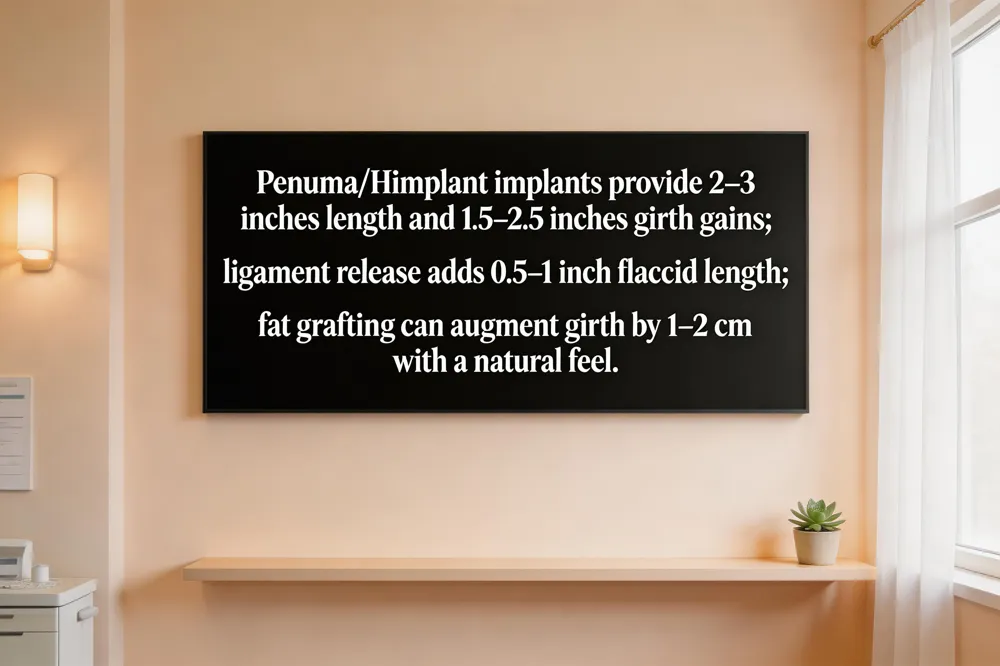
Penuma and Himplant silicone implants remain the most widely adopted volumetric solutions for combined length and girth enhancement. The XXL Penuma, the largest size in the Penuma system, typically adds 2–3 inches (5–7.5 cm) of flaccid length and 1.5–2.5 inches of girth, with results that appear natural when placed by a board‑certified plastic surgeon.
Suspensory ligament release (ligamentolysis) is performed under local or regional anesthesia and involves cutting the suspensory ligament to allow a greater portion of the shaft to hang externally. V‑Y or cross‑plasty skin techniques prevent re‑attachment and preserve a smooth contour. Post‑operative stretching protocols are essential to maintain the gain, and most patients resume light activities within a few days.
Autologous fat grafting can be combined with either implant or ligament release to augment girth, correct asymmetry, and improve tissue quality. Harvested fat from the abdomen or thighs is purified, enriched with stem‑cell‑rich plasma in many cases, and micro‑injected into the penile shaft, offering a soft, natural feel and long‑lasting volume retention.
Best‑in‑class male enlargement surgery therefore integrates a permanent, FDA‑cleared implant (Penuma or Himplant) with adjunctive fat grafting when additional girth or contour refinement is desired, delivering durable, natural‑looking outcomes while minimizing foreign‑material complications.
Fat Grafting Techniques and Expected Gains

Penile autologous fat transfer begins with a safe‑suction harvest from the abdomen, thighs, or buttocks. The lipoaspirate is washed, filtered into micro‑fat or nanofat, and then injected in multiple small, evenly spaced parcels under the tunica albuginea, creating a smooth, natural‑looking contour while preserving sensation and eliminating allergic risk.
Typical outcomes show an average girth increase of 1–2 cm (‑0.4–0.8 in) per session, with some men reporting up to 30 % circumference growth and a modest 0.5–1 cm (¼–½ in) length gain when combined with ligament release. Long‑term retention varies; studies report 50‑70 % of grafted fat survives 6–12 months, providing semi‑permanent enhancement that feels like native tissue. Patient satisfaction is high, with 94 % of men in a 42‑patient series rating results as natural and aesthetically pleasing.
For those seeking permanent girth, fat grafting offers a durable, body‑compatible alternative to synthetic fillers, which are temporary, may migrate, and carry higher allergic‑reaction risk. Multiple staged transfers can increase total gain to 1–2 cm in girth and up to 1 cm in length when donor fat is abundant and surgical technique is optimal.
Adjunct Practices, Recovery, and After‑Care

A healthy lifestyle can make the penis appear larger. Reducing abdominal fat, regular aerobic exercise, a balanced diet, quitting smoking, and pelvic‑floor (Kegel) training improve vascular health and erectile firmness, but no home technique permanently lengthens or widens the organ.
Suspensory ligament release – pre‑ and post‑op: Before surgery the shaft may be recessed or buried by excess pubic fat. The release detaches the dorsal ligament, giving an immediate 0.5–1 inch gain in flaccid length and a more forward‑pointing erection. Post‑operatively patients experience swelling, bruising, and limited erections for 1‑2 weeks; activity resumes in 3–5 days and full projection settles by 4‑6 weeks.
Recovery timeline: Surgical options (fat grafting, ligament release) require a brief donor‑site healing period (1‑2 weeks) and a return to light activities within a week. Non‑surgical synthetic fillers have minimal downtime but need repeat injections every 6‑12 months to maintain volume. Both approaches should be performed by a board‑certified specialist such as Dr. Victor Liu for optimal safety and outcomes.
Conclusion
Fat grafting has become the preferred choice for many men because it uses the patient’s own tissue, eliminating allergic risk and providing a natural, pliable feel that synthetic fillers cannot match. The procedure offers durable girth and modest length gains, integrates stem cells that improve skin quality, and can be combined with body‑contouring for added aesthetic benefit—all while maintaining a low complication profile when performed by an experienced surgeon. Dr. Victor Liu’s board‑certified practice delivers individualized assessment, meticulous technique, and comprehensive postoperative care to ensure safe, lasting results. Schedule a confidential consultation with Dr. Liu to discuss a personalized enhancement plan.